2026-02-12 中国科学院(CAS)
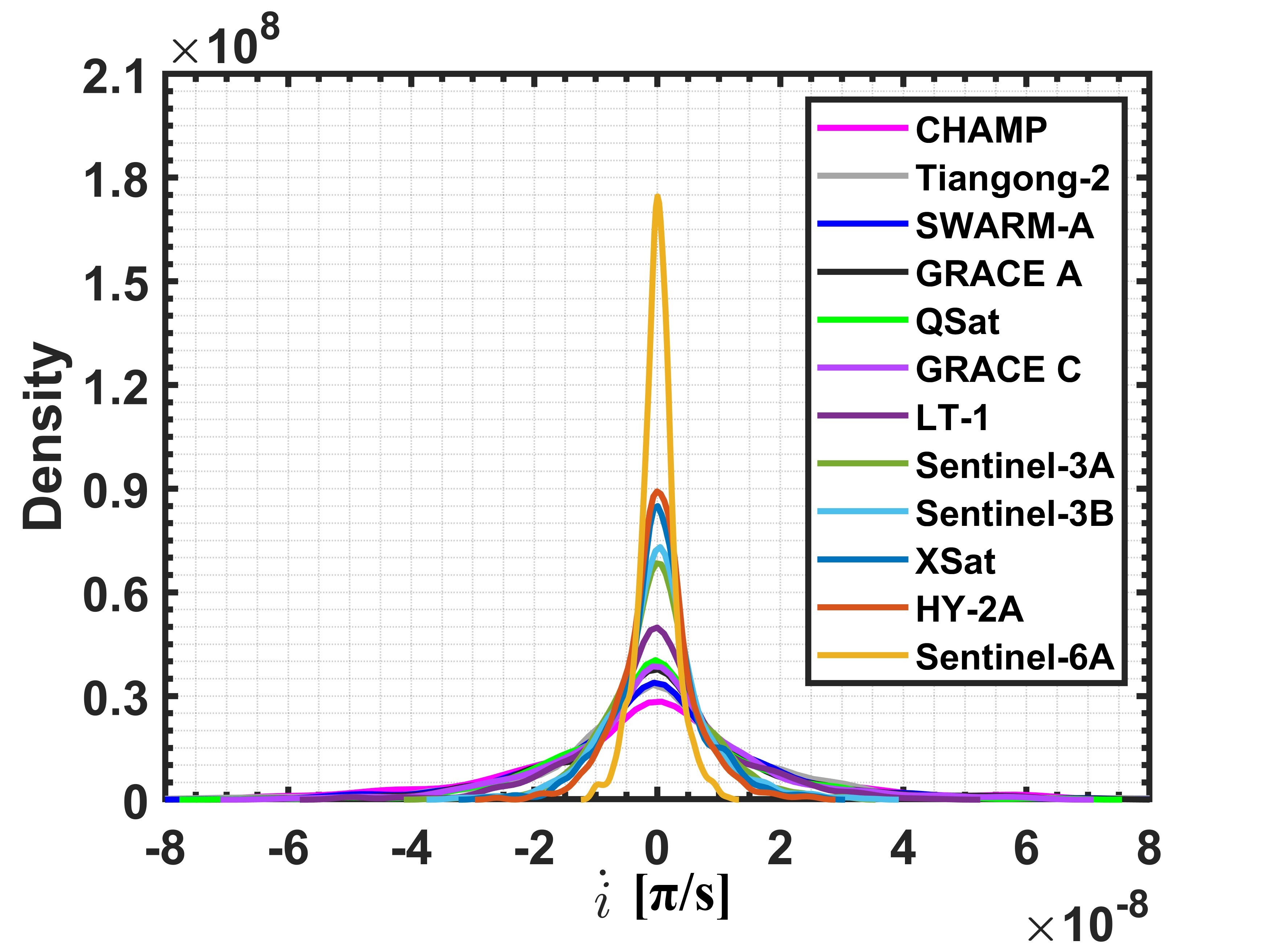
Probability density distribution of the orbital inclination rate using the 16-parameter model with a 10-min fitting interval for the 12 selected LEO satellites. The satellites are ranked from low to high altitudes in the legend (Image by WEI Chunbo& WANG Kan)
<関連情報>
- https://english.cas.cn/newsroom/research-news/202602/t20260226_1151211.shtml
- https://link.springer.com/article/10.1007/s10291-026-02032-w
LEO衛星エフェメリスの確率分布とフィッティング精度の特性 Characteristics of probability distribution and fitting accuracy for LEO satellite ephemeris
Chunbo Wei & Kan Wang
GPS Solutions Published:10 February 2026
DOI:https://doi.org/10.1007/s10291-026-02032-w
Abstract
Low Earth Orbit (LEO) satellites have nowadays shown great potential to enhance the existing GNSSs for better Positioning, Navigation, and Timing (PNT) services. Despite the requirements for high-accuracy real-time orbits, it is also crucial to broadcast high-accuracy and reliable ephemeris for constructing LEO-augmented PNT services. For LEO satellites, the distribution of various ephemeris parameters is of concern as setting proper thresholds is important when designing the satellite navigation message, yet it is rarely studied. In this contribution, the probability distribution of the ephemeris parameters of LEO satellites is investigated together with their fitting accuracies. Twelve LEO satellites flying at different altitudes (300–1400 km) with different orbital characteristics are selected for 16-, 18-, 20-, and 22-parameter ephemeris fitting. The results reveal that an increase in orbital altitude not only leads to improved ephemeris fitting accuracy but also results in a more concentrated distribution of ephemeris parameters. Reducing the ephemeris fitting interval and increasing the number of ephemeris parameters both contribute positively to improving the fitting accuracy, i.e., around 1 cm or lower for 20/22-parameter ephemeris models with a 10-min fitting interval for orbital altitudes ranging from 300 to 1400 km. This, nevertheless, comes at the cost of dispersed distribution of the ephemeris parameters, i.e., with wider thresholds for effective ranges of the ephemeris parameters. It was also found that the values of certain crucial ephemeris parameters, e.g., the orbital right ascension of the ascending node rate, the mean motion correction, and the second-order term of the harmonic corrections (Cus2, Crc2), are highly correlated with both the orbital altitudes and the inclinations. This requires special attention when designing the broadcast ephemeris for LEO navigation augmentation systems.