2026-02-13 中国科学院(CAS)
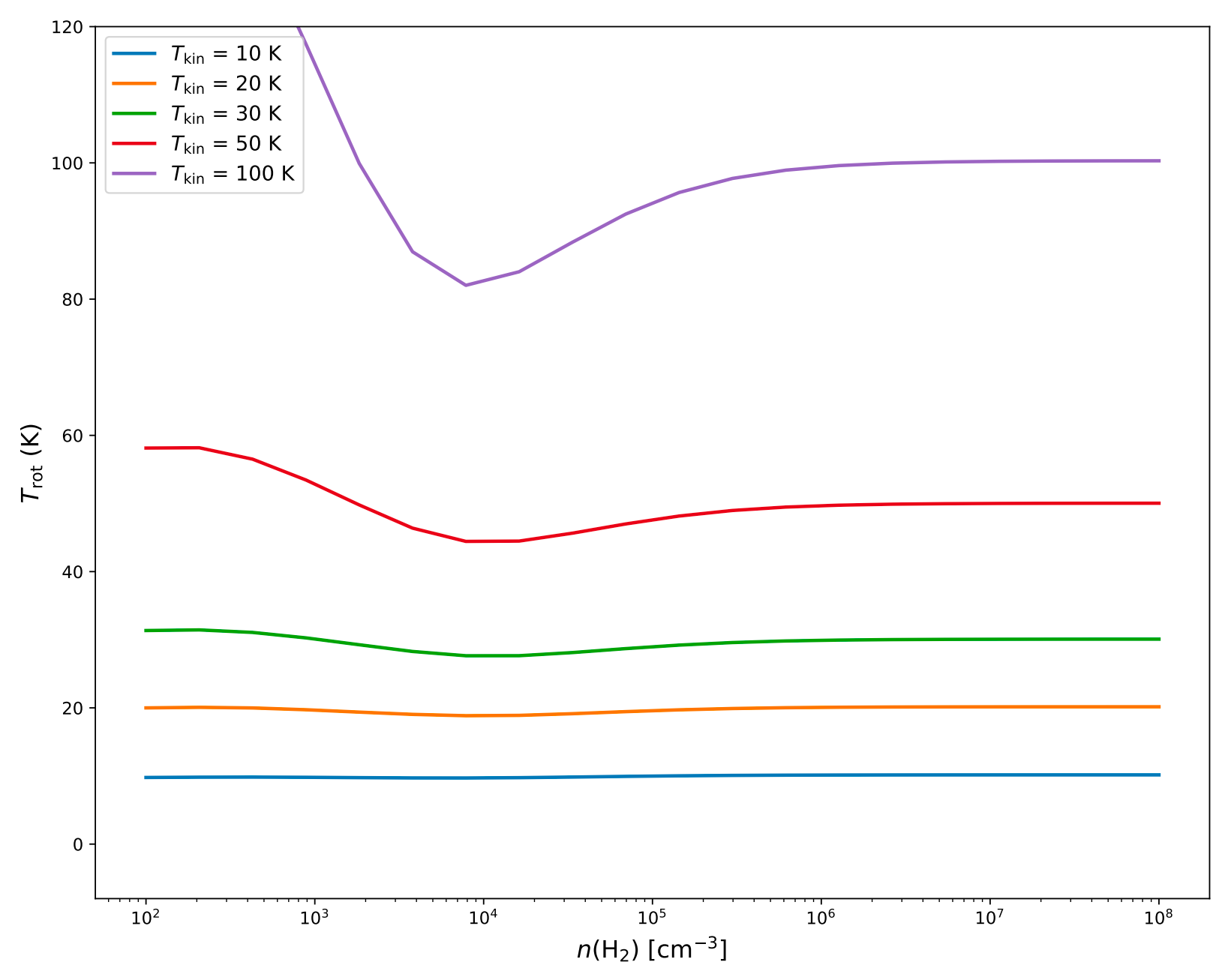
Statistical equilibrium calculation results for CH₃CCH. At densities above 10⁴ cm⁻³, the rotation temperature derived from CH₃CCH is essentially consistent with the gas temperature. (Image by SHAO)
<関連情報>
- https://english.cas.cn/newsroom/research-news/202602/t20260226_1151230.shtml
- https://iopscience.iop.org/article/10.3847/1538-4357/ae33bc
温かい分子ガス中の温度計としてのCH3CCH CH3CCH as a Thermometer in Warm Molecular Gas
Yuqiang Li, Junzhi Wang, Juan Li, Xing Lu, Siqi Zheng, Chao Ou, Qian Huang, Miguel Santander-García, José Jairo Díaz-Luis, Seokho Lee,…
The Astrophysical Journal Published: 2026 February 9
DOI:10.3847/1538-4357/ae33bc
Abstract
Kinetic temperature is a fundamental parameter in molecular clouds. Symmetric top molecules, such as NH3 and CH3CCH, are often used as thermometers. However, at high temperatures, NH3(2,2) can be collisionally excited to NH3(2,1) and rapidly decay to NH3(1,1), which can lead to an underestimation of the kinetic temperature when using rotation temperatures derived from NH3(1,1) and NH3(2,2). In contrast, CH3CCH is a symmetric top molecule with lower critical densities of its rotational levels than those of NH3, which can be thermalized close to the kinetic temperature at relatively low densities of about 104 cm−3. To compare the rotation temperatures derived from NH3(1,1) and (2,2) and CH3CCH rotational levels in warm molecular gas, we used observational data toward 55 massive star-forming regions obtained with Yebes 40 m and TMRT 65 m. Our results show that rotation temperatures derived from NH3(1,1) and (2,2) are systematically lower than those from CH3CCH 5–4. This suggests that CH3CCH rotational lines with the same J+1 → J quantum number may be a more reliable thermometer than NH3(1,1) and (2,2) in warm molecular gas located in the surroundings of massive young stellar objects or, more generally, in massive star-forming regions.