2026-02-16 北海道大学
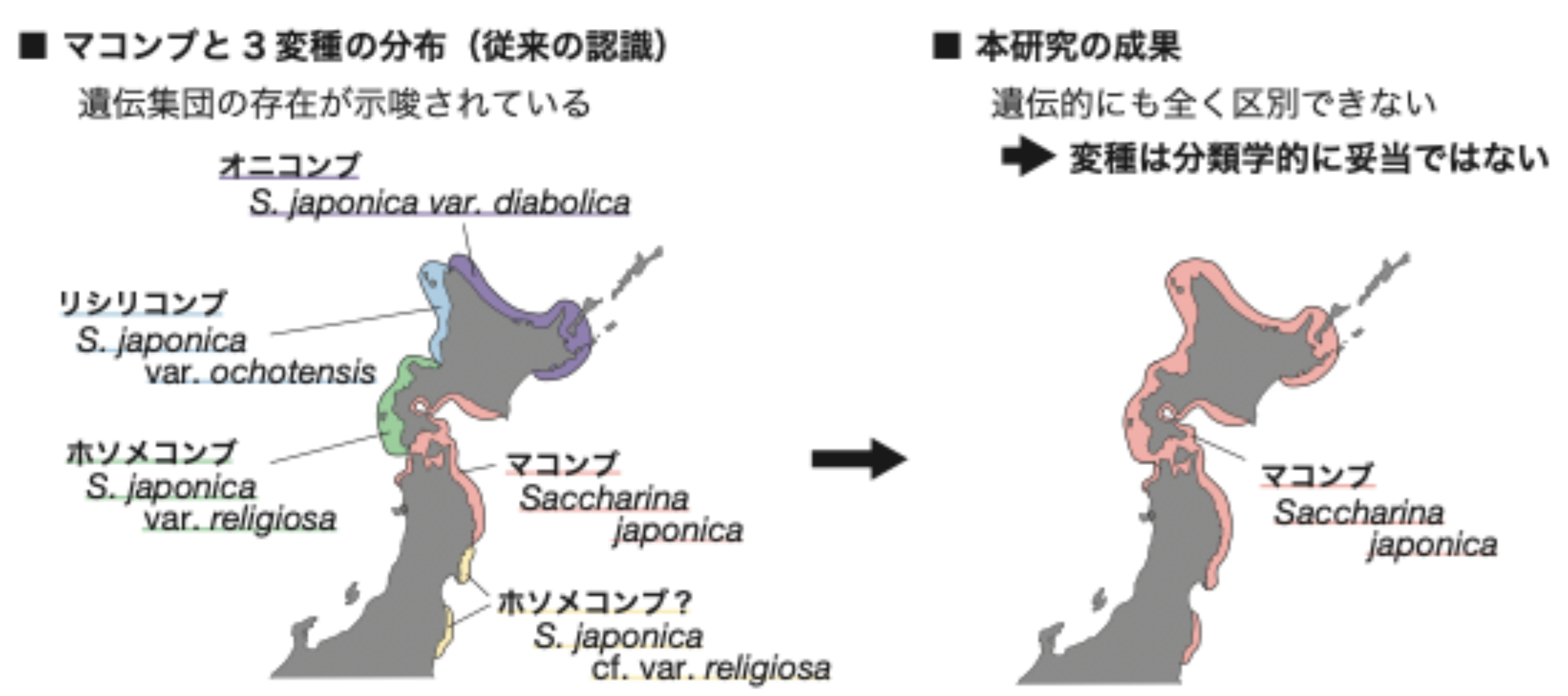
本研究の概念図
<関連情報>
- https://www.hokudai.ac.jp/news/2026/02/post-2185.html
- https://www.hokudai.ac.jp/news/pdf/260216_pr.pdf
- https://onlinelibrary.wiley.com/doi/10.1111/jpy.70120
マコンブの変種を支持する遺伝集団は存在しない。変種の分類学的な統合の提案Lack of genetic support for varieties in Saccharina japonica (Laminariales, Phaeophyceae): Proposal for taxonomic merger
Shingo Akita, Kenta Chizaki, Yuki Hosoyama, Chikara Kawagoe, Toshiki Uji, Daisuke Fujita, Christophe Vieira, Hiroyuki Mizuta
Journal of Phycology Published: 08 January 2026
DOI:https://doi.org/10.1111/jpy.70120
Abstract
Following the treatment of Saccharina diabolica, S. ochotensis, and S. religiosa as varieties of S. japonica, the same authors reported independent genetic groups corresponding to the original distributions of these species described in 1902. However, other population genetic studies have not supported these genetic groups corresponding to the varieties, and these varietal names have been applied predominantly to the Japanese population, despite S. japonica having a broader distribution in North Korea and the Russian Far East. This study reevaluated the taxonomic validity of these varieties by investigating the presence of corresponding genetic groups within Japan. We collected 475 individuals across its Japanese distribution, assigned them to five groups based on prior research, and genotyped them using 12 simple sequence repeat (SSR) markers. STRUCTURE analysis, discriminant analysis of principal components scatter plots, and isolation by distance analyses did not support the presence of distinct genetic clusters aligning with the described distributions of S. japonica and its varieties. Instead of confirming the previously demonstrated genetic groups, these analyses revealed either two or three large, geographically based genetic clusters or smaller genetic groups composed of neighboring localities. Consequently, this study has proposed the merger of the three varieties into a single species, S. japonica. Furthermore, we have proposed new combinations of several formae under S. japonica as they have retained their previous taxonomic status under Laminaria japonica or L. diabolica. Further research is required to assess the taxonomic validity of these formae.