2026-02-12 スイス連邦工科大学ローザンヌ校(EPFL)
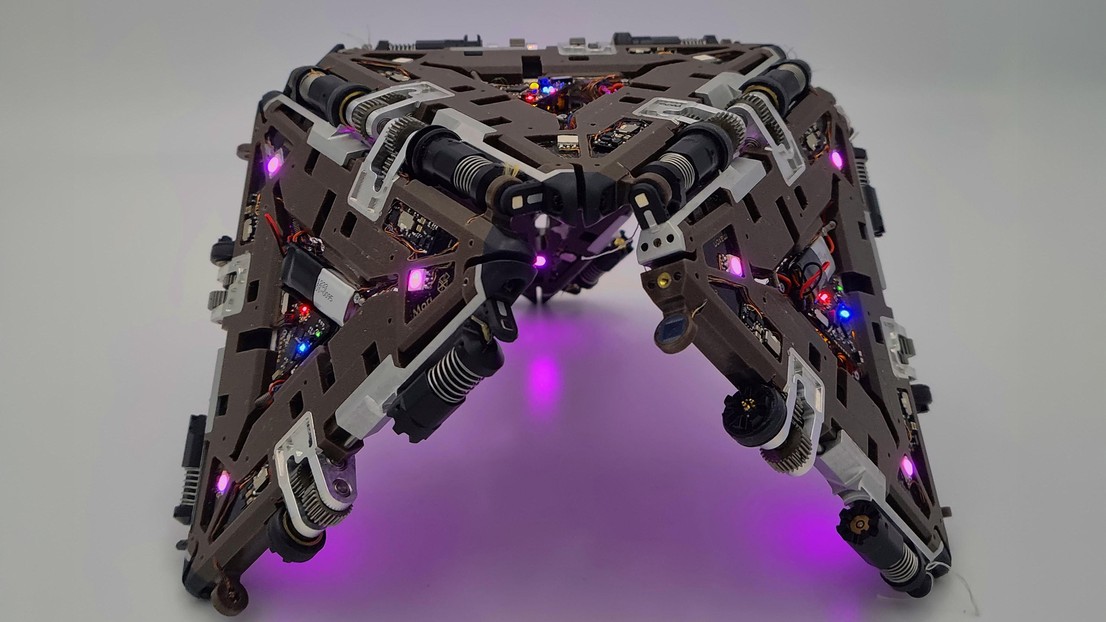
The Mori3 modular origami robot. 2026 EPFL CC BY SA
<関連情報>
- https://actu.epfl.ch/news/resource-sharing-boosts-robotic-resilience-2/
- https://www.science.org/doi/10.1126/scirobotics.ady6304
リソースの共有によるスケーラブルなロボット集団の回復力 Scalable robot collective resilience by sharing resources
Kevin Holdcroft, Anastasia Bolotnikova, Antoni Jubés Monforte, and Jamie Paik
Science Robotics Published:11 Feb 2026
DOI:https://doi.org/10.1126/scirobotics.ady6304
Abstract
No system is immune to failure. The compromise between reducing failures and improving adaptability is a recurring problem in robotics. Modular robots exemplify this tradeoff, because the number of modules dictates both the possible functions and the odds of failure. We reverse this trend, improving reliability with an increased number of modules by exploiting redundant resources and sharing them locally. We present a unified methodology for local resource sharing; local power sharing balances energy distribution, hybrid communication spreads messages, and local sensor fusion propagates full system state estimate information among the robot collective. We present the experimental results of our methodology applied to a modular robot, Mori3. Despite one module being deprived of its own resources in terms of power, sensing, and communication, the robot collective can successfully perform a locomotion mission in a challenging environment, thanks to neighboring modules supporting each other via our proposed resource-sharing methodology.