2026-02-12 東京大学
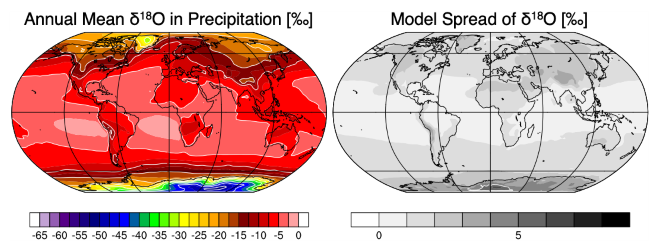
8つの水同位体気候モデルによる降水中の酸素同位体比(δ18O;左)とそのばらつき(右)
<関連情報>
- https://www.iis.u-tokyo.ac.jp/ja/news/4990/
- https://agupubs.onlinelibrary.wiley.com/doi/10.1029/2025JD044985
水同位体モデル相互比較プロジェクト(WisoMIP):現在の気候 Water Isotope Model Intercomparison Project (WisoMIP): Present-Day Climate
Hayoung Bong, Allegra N. LeGrande, Sylvia Dee, Jiang Zhu, Alexandre Cauquoin, Richard P. Fiorella, Qinghua Ding, Niels Dutrievoz, Masahiro Tanoue, Michelle Frazer, Mampi Sarkar, …
Journal of Geophysical Research: Atmospheres Published: 10 February 2026
DOI:https://doi.org/10.1029/2025JD044985
Abstract
We present the first results of the Water Isotope Model Intercomparison Project (WisoMIP), with Phase 1 focused on modern simulations (1979–2023) from a suite of isotope-enabled atmospheric general circulation models nudged to ERA5 reanalyzes. Water sources, mixing, and rainout history influence the isotopic composition of vapor and precipitation, making these simulations powerful tools for tracing the global water cycle. By prescribing identical winds, sea surface temperatures, and sea ice conditions, we isolate differences in water isotope behavior across models, controlling for variability in atmospheric dynamics and mean climate. Our analyses show that the ensemble mean best matches observations, as individual model errors cancel out to yield a more accurate representation of Earth’s isotope distributions. We also evaluate trends and responses to major climate modes during the recent warming period, highlighting regional and temporal sensitivities in the isotope signals. These diagnostics extend beyond traditional model evaluation metrics (e.g., temperature, precipitation) to reveal uncertainties in physical processes and guide improvements in model parameterizations. The resulting modern nudged ensemble data set serves as a benchmark for isotope-enabled model development, satellite product comparison, and understanding of water cycle changes in a warming climate. Given its standardized design and broad participation, WisoMIP provides a valuable “isotope reanalysis” product for applications ranging from paleoclimate reconstruction to model tuning. Our work demonstrates the importance of coordinated isotope model evaluation in advancing the use of water isotopes as a diagnostic tool in climate science.
Plain Language Summary
Water molecules can have slightly different weights depending on the types of hydrogen and oxygen atoms they contain. These are called water isotopologues, or more simply, water isotopes. This study focuses on stable water isotopes, which serve as natural fingerprints that help track how water moves through the atmosphere, oceans, and land. They are especially useful for studying cloud processes, rainfall, temperature, and humidity, and can even reveal past climate conditions using ice cores or cave deposits. Many climate models can now simulate water isotopes, but they often produce different results, making it difficult to assess accuracy. To address this, the international Water Isotope Model Intercomparison Project (WisoMIP) tested several leading climate models by using the same conditions for winds, sea surface temperatures, and sea ice. This study compares WisoMIP model simulations over the period 1979–2023. By analyzing the models side by side and evaluating them against observations, the project identifies where the models agree, where they diverge, and why. These insights improve our understanding of water movement in the climate system and help refine climate models. The WisoMIP data set offers a valuable global resource for studying Earth’s water cycle now and under future climate change.
Key Points
- Eight isotope-enabled climate models were nudged with the same winds and sea surface temperatures to compare water isotope simulations
- The ensemble mean best captures oxygen and hydrogen isotope patterns observed in global precipitation, vapor, snow, and satellite data
- Isotope changes from warming and climate modes reflect shifts in moisture transport, convergence, and large-scale atmospheric circulation