2026-02-02 マサチューセッツ工科大学(MIT)
<関連情報>
- https://news.mit.edu/2026/how-generative-ai-can-help-scientists-synthesize-complex-materials-0202
- https://www.nature.com/articles/s43588-025-00949-9
DiffSyn: 材料合成計画のための生成的拡散アプローチ DiffSyn: a generative diffusion approach to materials synthesis planning
Elton Pan,Soonhyoung Kwon,Sulin Liu,Mingrou Xie,Alexander J. Hoffman,Yifei Duan,Thorben Prein,Killian Sheriff,Yuriy Roman-Leshkov,Manuel Moliner,Rafael Gomez-Bombarelli & Elsa A. Olivetti
Nature Computational Science Published:02 February 2026
DOI:https://doi.org/10.1038/s43588-025-00949-9 A preprint version of the article is available at arXiv.
Abstract
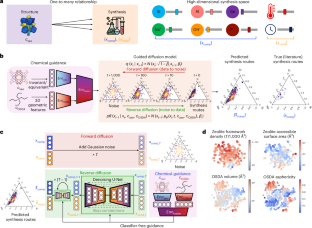
The synthesis of crystalline materials, such as zeolites, remains a notable challenge owing to a high-dimensional synthesis space, intricate structure–synthesis relationships and time-consuming experiments. Here, considering the ‘one-to-many’ relationship between structure and synthesis, we propose DiffSyn, a generative diffusion model trained on over 23,000 synthesis recipes that span 50 years of literature. DiffSyn generates probable synthesis routes conditioned on a desired zeolite structure and an organic template. DiffSyn a chieves state-of-the-art performance by capturing the multi-modal nature of structure–synthesis relationships. We apply Diffsny to differentiate among competing phases and generate optimal synthesis routes. As a proof of concept, we synthesize a UFI material using DiffSyn-generated synthesis routes. These routes, rationalized by density functional theory binding energies, resulted in the successful synthesis of a UFI material with a high Si/AlICP of 19.0, which is expected to improve thermal stability.