2026-02-03 琉球大学
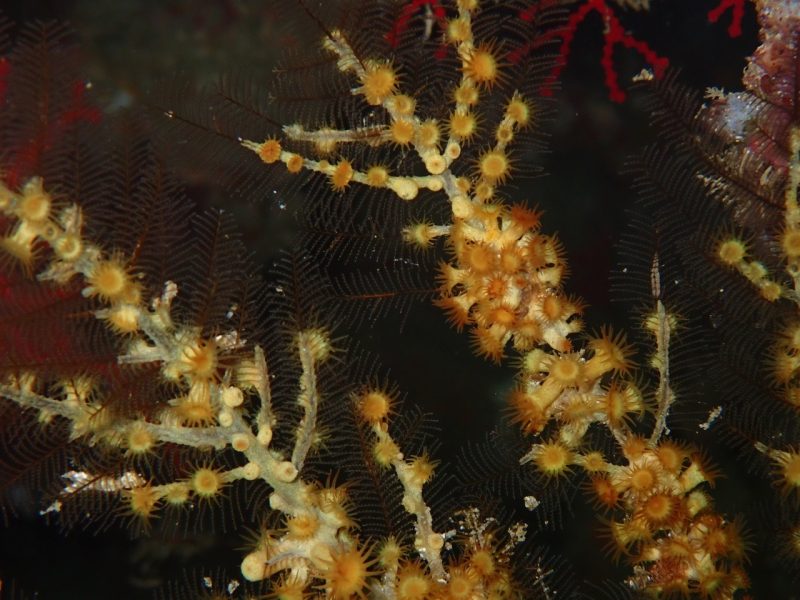
② 沖縄のセンナリスナギンチャク(Hydrozoanthus gracilis)
<関連情報>
- https://www.u-ryukyu.ac.jp/news/75399/
- https://www.u-ryukyu.ac.jp/wp-content/uploads/2026/02/35ca3f6ae1dbcdf77ba5660fd188ad1e.pdf
- https://biogeography.pensoft.net/article/174247/
ゾアンサリアの世界的生物地理学は、大西洋とインド太平洋の間の遺伝的差異が弱く、熱帯と温帯の地域に異なる群集が存在することを示している Global biogeography of zoantharians indicates a weak genetic differentiation between the Atlantic and Indo-Pacific oceans, and distinct communities in tropical and temperate provinces
Maria E. A. Santos, Hiroki Kise, Chloé Julie Loïs Fourreau, Bogdan Kiriukhin, Marcelo Visentini Kitahara, David Michael Baker, Robert J. Toonen, Pi Jen Liu, Arthur Chang, Ting-Hsuan Tu, Widiastuti, Kadek Miko Purnama Agustini, Brian W. Bowen, James D. Reimer
Frontiers in Biogeography Published:30 Jan 2026
DOI:https://doi.org/10.21425/fob.19.174247
Abstract
Biogeographic patterns for marine fishes and scleractinian stony corals are well-established, but it is still unclear whether these patterns apply to the understudied marine invertebrates. Here we investigate the distribution of zoantharians (=zoanthids), an order of cnidarians that are distributed globally from tropical coral reefs to deep temperate oceans. We examined the available literature, along with new records and morphological and DNA sequence data, to establish their first global biogeographical assessment. Two striking results emerged that contrast with previously known marine biogeographical patterns. The first was that several zoantharian genera are cosmopolitan, inhabiting most biogeographic provinces within and between ocean basins. Although the highest diversity was observed in the Indo-Pacific Ocean (IPO), concordant with biogeographic assays of reef fishes and stony corals, the distribution of genera was not significantly different between the Atlantic (ATO) and the IPO. Secondly, there were multiple sibling species complexes between the ATO and the IPO. At species and population scales, a long pelagic larval duration, asexual reproduction modes, and rafting abilities, may at least partly explain the low levels of genetic differences between ocean basins. As some zoantharian species can play a significant role in phase shifts, filling knowledge gaps on species distributions is essential to support monitoring of reef ecosystems.
Highlights
- Our study revealed that several Zoantharia genera, and most families, are globally distributed.
- This is highly distinct from the pattern previously observed for common reef animals, such as stony corals and fishes, where the Indo-Pacific Ocean has several times the number of familes/genera compared to the Atlantic Ocean.
- Some zoantharian species, especially in the genera Palythoa and Zoanthus, have dispersal strategies that allow for broad distributions within ocean basins, while the vicariant events of the rise of the Isthmus of Panama and the appearance of the Benguela upwelling likely prompted the speciation of sibling lineages between the oceans.