2026-01-27 オークリッジ国立研究所(ORNL)
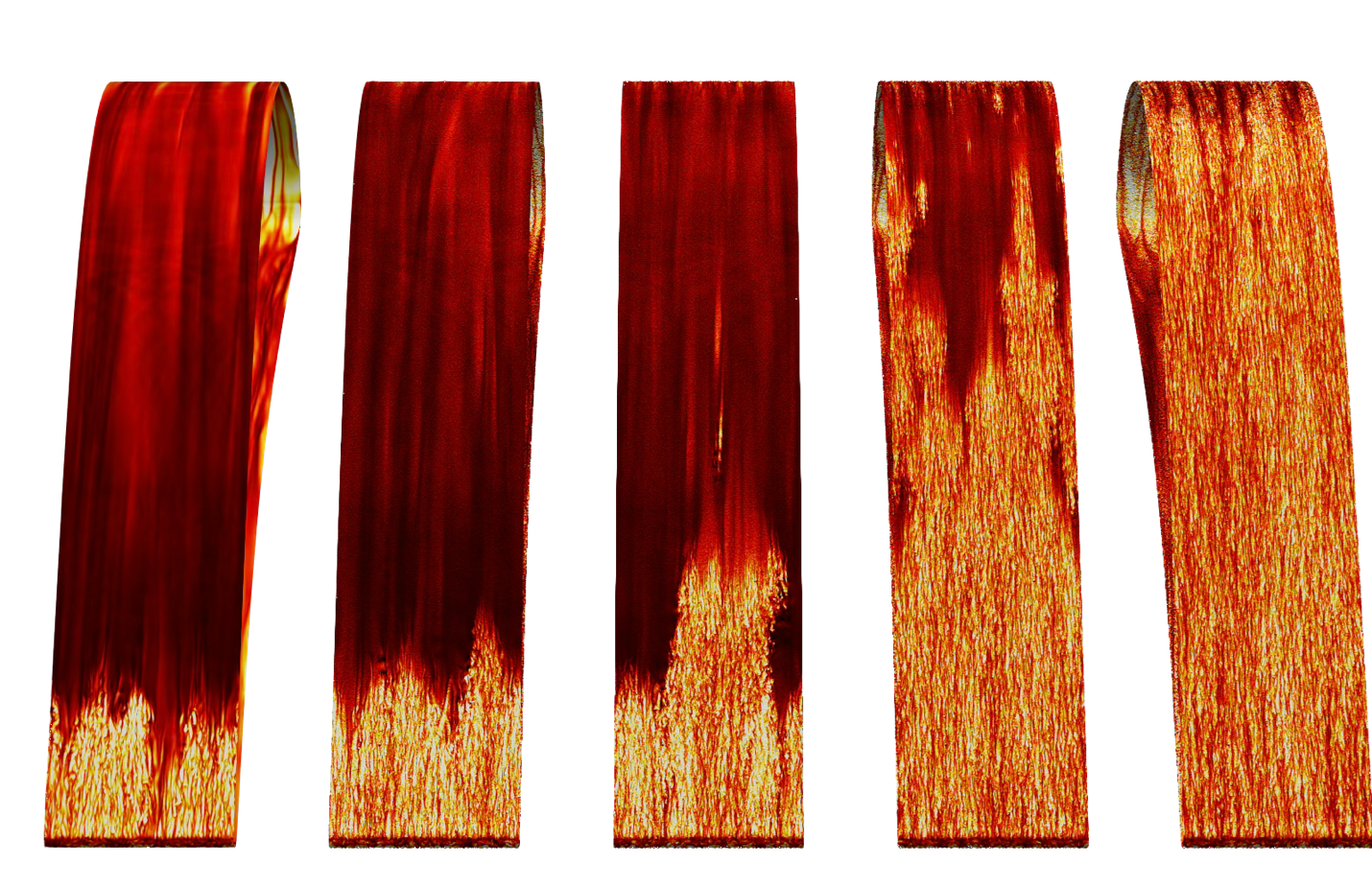
This visualization shows the instantaneous wall heat flux on the suction surface of turbine blades in a high-pressure turbine engine. The levels of surface roughness in the leading-edge region are increasing from left to right. Credit: Thomas Jelly, University of Melbourne in Australia
<関連情報>
- https://www.ornl.gov/news/frontier-provides-high-fidelity-insights-turbine-aerothermal-performance
- https://asmedigitalcollection.asme.org/turbomachinery/article/147/5/051017/1210234/Effects-of-Localized-Non-Gaussian-Roughness-on
局所的非ガウス粗さが高圧タービンの空力熱性能に与える影響:対流熱伝達、表面摩擦、レイノルズ類推 Effects of Localized Non-Gaussian Roughness on High Pressure Turbine Aero-Thermal Performance: Convective Heat Transfer, Skin-Friction and the Reynolds’ Analogy
Thomas O. Jelly,Massimiliano Nardini,Richard D. Sandberg,Paul Vitt,Greg Sluyter
Journal of Turbomachinery Published:December 20, 2024
DOI:https://doi.org/10.1115/1.4067354
Abstract
Compressible direct numerical simulations are conducted to investigate how surface roughness affects the aerothermal performance of a high-pressure turbine vane operating at an exit Reynolds number of 0.59 and exit Mach number of 0.92. The roughness under investigation here was synthesized with non-Gaussian statistical properties and an amplitude that varies over its chord length, representative of what truly occurs on an in-service vane. Particular attention is directed toward how systematically changing the axial extent of leading edge roughness affects convective heat transfer (Nusselt and Stanton numbers) and aerodynamic drag (skin friction coefficient) on the pressure and suction surfaces. The results of this investigation demonstrate that moving the larger amplitude roughness further along the suction surface can alter the blade boundary layer state. In fact, toward the trailing edge of one of the rough vanes investigated here, the local skin friction coefficient increases by a factor of 22 compared to smooth-vane levels, whereas the local Nusselt number increases by a factor 6. The disproportionate rise of drag compared to heat transfer is explored in further detail by quantifying the Reynolds’ analogy and by calculating the fractional contributions of pressure drag and viscous drag to the total drag force. The effect of varying the inlet turbulence intensity and integral length scale for a fixed roughness topography is also investigated, and the Reynolds number scaling of heat transfer and drag is examined in the context of the Chilton–Colburn analogy.