2026-01-22 中国科学院(CAS)
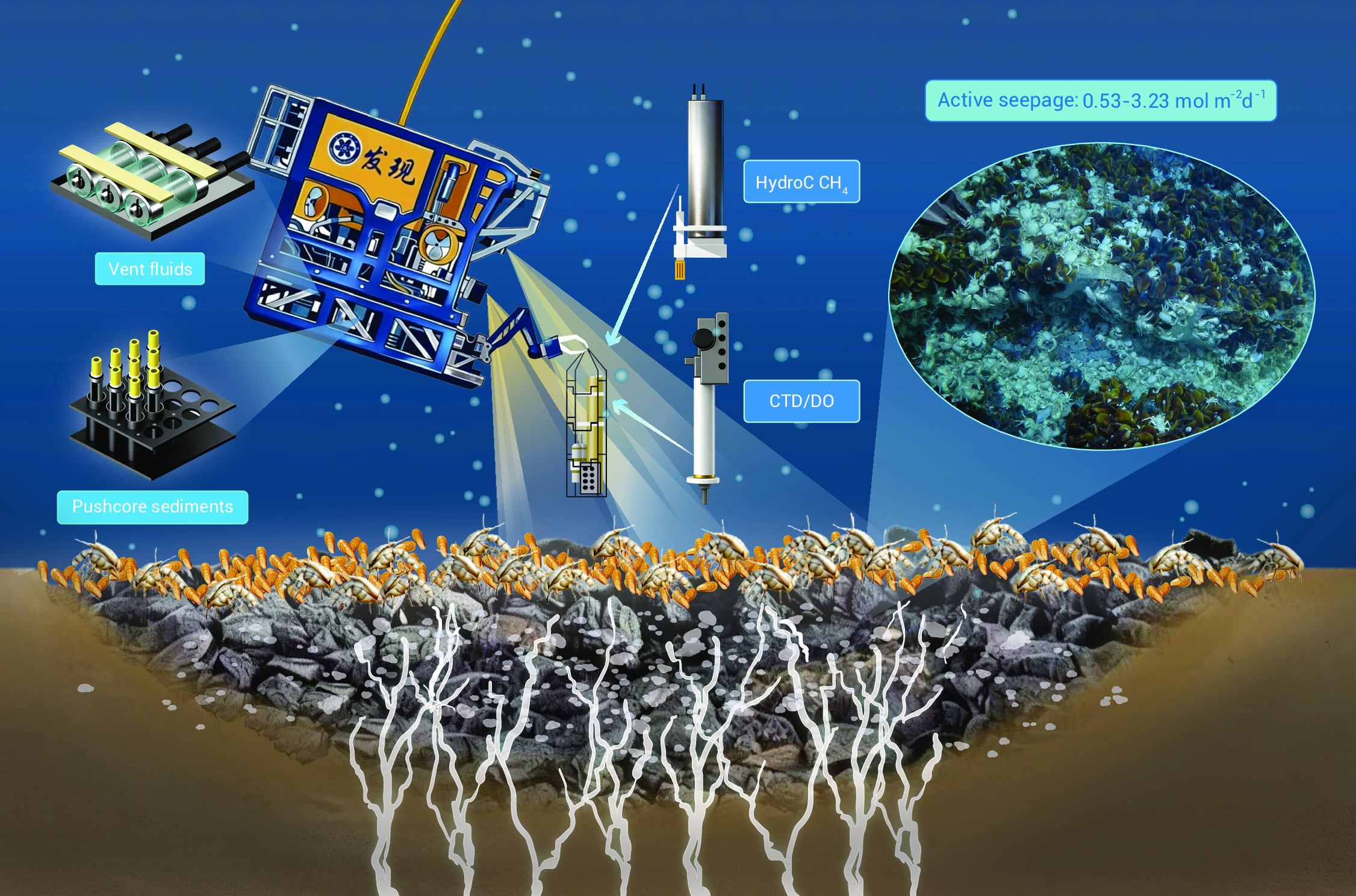
In situ detection of methane fluxes from active cold seep in the South China Sea. (Image by IOCAS)
<関連情報>
- https://english.cas.cn/newsroom/research-news/202602/t20260210_1150358.shtml
- https://www.the-innovation.org/article/doi/10.59717/j.xinn-geo.2026.100192
南シナ海フォルモサ海嶺の活動的なコールドシープにおけるメタン動態の現地観測 In situ observations of methane dynamics in an active cold seep of the Formosa Ridge, the South China Sea
Lei Cao, Chao Lian, Xiangbin Ran, Huan Zhang, Hao Wang, Li Zhou, Hao Chen, Zhaoshan Zhong, Minxiao Wang, Chaolun Li
The Innovation Geoscience Published:January 01, 2026
DOI:https://doi.org/10.59717/j.xinn-geo.2026.100192
PUBLIC SUMMARY
- Methane released by cold seep profoundly affects the marine environment and contributes to climate change.
- In situ observations coupled with steady-state model are employed to quantify methane fluxes from cold seep.
- Horizontal advection is the primary migration mechanism for released methane in the active cold seep.
- The contribution of methane from deep sea cold seeps to the global methane budget have been underestimated.
ABSTRACT
Methane eruptions from active cold seeps profoundly impacts the marine environment and contributes to climate change. However, in situ measurements available to constrain the efflux of methane from active seeps are scarce. In this study, in situ observations coupled with steady-state model were initially used to evaluate the flux and fate of methane released into the hydrosphere at the cold seep site F. Findings from three years of data indicated that horizontal advection is the primary migration and removal mechanism for released methane, followed by vertical diffusion and microbial oxidation. Methane flux in the active seepage (0.53-3.23 mol m-2 d-1) estimated by the in-situ approach was several orders of magnitude greater than that from the sediment-water interface. This would result in 0.70 – 4.22 Gmol yr-1 methane being released into the South China Sea (SCS) continental margins. Methane flux estimated based on the in situ observation here was significantly higher than that in the previously studied seeps. The regional methane fluxes from cold seeps in the SCS further suggest that dissolved methane discharge substantially contributes to the oceanic methane budget. Extrapolating the methane flux to active seeps worldwide would result in approximately 126 Tg C emitted into the hydrosphere annually as dissolved methane, indicating that the contribution of methane from deep-sea cold seeps to the global methane budget might have been underestimated. Our study emphasizes the deep-sea cold seeps as a significant methane source to the ocean and provides valuable insights into the quantitative assessment of the oceanic methane budget.