

2026-01-20 スイス連邦工科大学ローザンヌ校(EPFL)
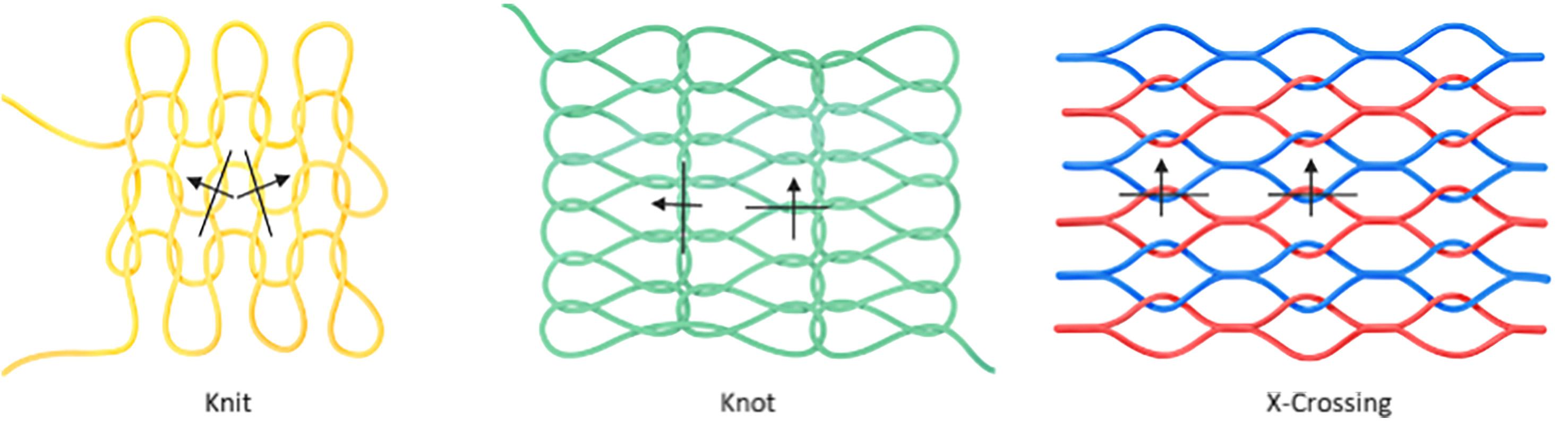
Different fabric architectures and their fiber crossing directions. 2026 LMTS EPFL CC BY SA
<関連情報>
- https://actu.epfl.ch/news/a-geometric-twist-boosts-the-power-of-robotic-te-2/
- https://www.science.org/doi/10.1126/sciadv.aeb6760
繊維の交差を揃えた力学情報に基づいたファブリックアクチュエータ Mechanics-informed fabric actuators with aligned fiber crossings
Huapeng Zhang and Herbert Shea
Science Advances Published:16 Jan 2026
DOI:https://doi.org/10.1126/sciadv.aeb6760
Abstract
Engineering unobtrusive mechanical assistance into daily-life clothing requires energy-dense yet compliant actuators with thin profiles. We report textile actuators by interlacing shape memory alloy (SMA) fibers in a periodic X-Crossing geometry, where fiber crossings align in the actuation contraction axis. An X-Crossing actuator design of 4.5 grams can be passively stretched to 160% and contracts by 50% when heated, lifting 1 kg, outperforming knitted and knotted SMAs. We developed a variable-stiffness mechanics model to predict material-level stress-strain behavior across temperatures and thus the force-contraction relation of device level. This model informs actuator design and control, geometric scaling, peak points in the force-contraction relation, and the theoretical upper bound of contraction strain. The maximum measured contraction strain of our actuators is 55%, a large step toward the upper bound that we calculate for general SMA fabric actuators. We demonstrate applications of the developed actuators and model in lifting weight and on-body compression.

