2026-01-07 九州大学
<関連情報>
- https://www.kyushu-u.ac.jp/ja/researches/view/1372
- https://www.kyushu-u.ac.jp/f/64353/26_0107_01.pdf
- https://journals.aps.org/prl/abstract/10.1103/y4y1-1ll6
暗号化された量子ビットは複製可能 Encrypted Qubits Can Be Cloned
Koji Yamaguchi and Achim Kempf
Physical Review Letters Published: 6 January, 2026
DOI: https://doi.org/10.1103/y4y1-1ll6
Abstract
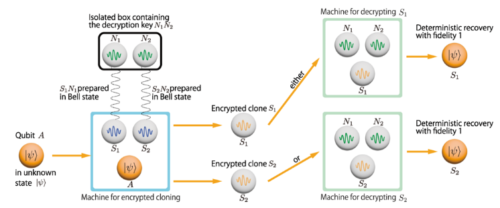
We show that encrypted cloning of unknown quantum states is possible. Any number of encrypted clones of a qubit can be created through a unitary transformation, and each of the encrypted clones can be decrypted through a unitary transformation. The decryption of an encrypted clone consumes the decryption key; i.e., only one decryption is possible, in agreement with the no-cloning theorem. Encrypted cloning represents a new paradigm that provides a form of redundancy, parallelism, or scalability where direct duplication is forbidden by the no-cloning theorem. For example, a possible application of encrypted cloning is to enable encrypted quantum multicloud storage.