

2025-12-30 パシフィック・ノースウェスト国立研究所(PNNL)
<関連情報>
- https://www.pnnl.gov/publications/growing-mesocrystals-through-nanoplatelet-oriented-sliding-and-attachment
- https://www.nature.com/articles/s41467-025-64852-7
ナノプレートの配向滑りと付着によるメソ結晶の成長 Mesocrystal growth through oriented sliding and attachment of nanoplates
Xiaoxu Li,Tuan A. Ho,Honghu Zhang,Lili Liu,Ruipeng Li,Ping Chen,Mark E. Bowden,Sebastian T. Mergelsberg,Hongyou Fan,James J. De Yoreo,Carolyn I. Pearce,Kevin M. Rosso & Xin Zhang
Nature Communications Published:15 December 2025
DOI:https://doi.org/10.1038/s41467-025-64852-7
Abstract
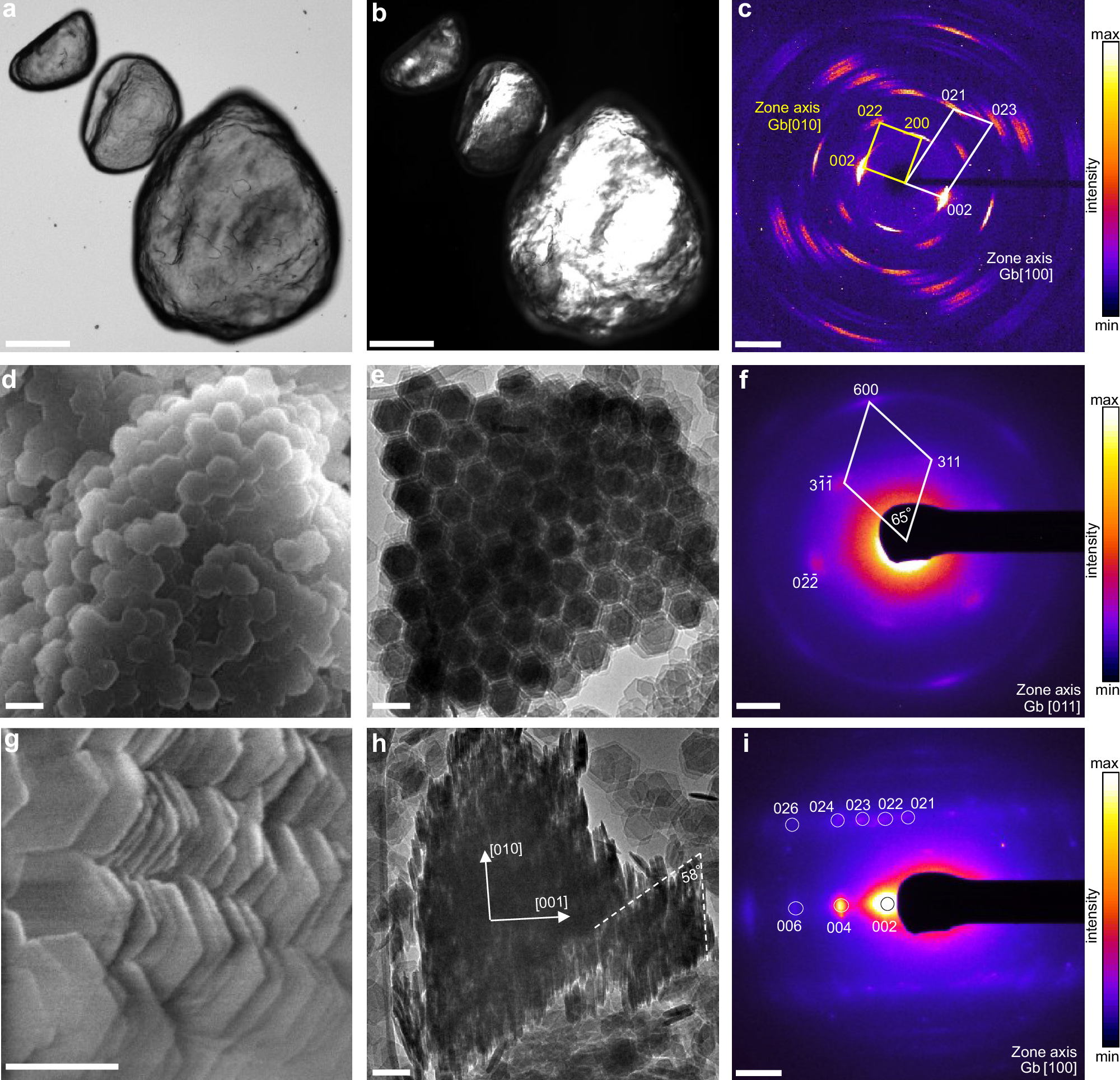
Oriented attachment is a critical, yet poorly understood, crystal growth pathway based on the self-assembly of nanocrystals. During oriented attachment, solvent-separated particles align and coalesce through forces that enable precise rotation and translation. While prior studies emphasized intragap forces driving crystallographic alignment, the forces enabling uniform stacking and superlattice formation remain unclear. Here, we demonstrate how macroscopic gibbsite mesocrystals emerge from nanoplates guided into staggered positions by directional sliding. Electron microscopy and X-ray scattering reveal the monoclinic superlattice structure, based on nanoplate stacking with a uniform ≈50° stagger along the gibbsite [010] direction. In situ liquid-cell TEM captures preferential sliding along the gibbsite [010] direction, decelerating with increasing particle overlap. Molecular dynamics simulations reveal that this staggered arrangement corresponds to a global free-energy minimum, rather than full alignment. The simulations also confirm that sliding along the [010] direction is energetically favored and provide insight into the role of interfacial water in achieving long-range ordered assemblies. These insights highlight the energy landscape’s role in oriented attachment, with implications for material synthesis and hierarchical structures in nature.

