2025-09-18 中国科学院(CAS)
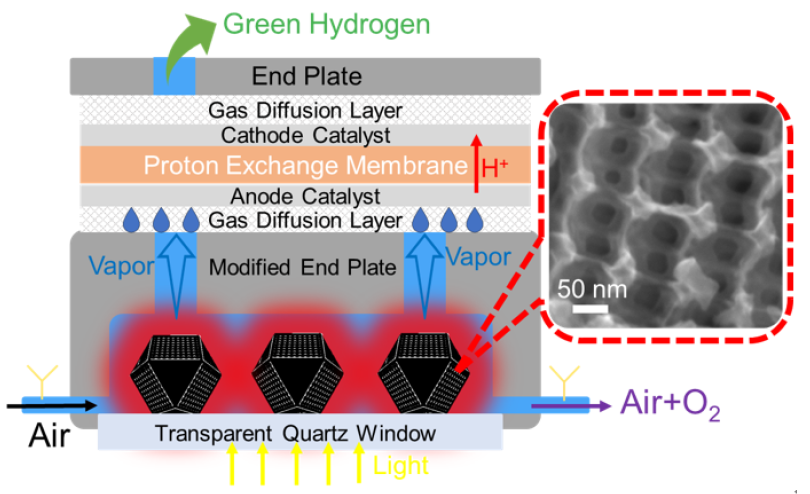
Self-sustaining air water harvesting and proton exchange membrane water electrolysis based on ordered porous carbon. (Image by YIN Huajie)
<関連情報>
- https://english.hf.cas.cn/nr/rn/202509/t20250918_1055021.html
- https://advanced.onlinelibrary.wiley.com/doi/10.1002/adma.202511336
階層的に配列した多孔質炭素を通じた太陽光駆動による大気水生成による自立型グリーン水素生産 Solar-Driven Atmospheric Water Production Through Hierarchically Ordered Porous Carbon for Self-Sustaining Green Hydrogen Production
Bo Fu, Jifang Zhang, Neil Robinson, Zhen Zhang, Zhengju Zhu, Mengyang Dong, Xinyuan Zhang, Jian Kang, Paul Michalski, Zeyang Zhao, Jiapeng Ji, Yiming Xu, Kaidi Zhang, Xinyu Wang, Shan Chen, …
Advanced Materials Published: 19 August 2025
DOI:https://doi.org/10.1002/adma.202511336
Abstract
Green hydrogen production by proton exchange membrane water electrolysis (PEMWE) powered by clean energy is a promising and environmentally friendly technology. However, it relies on a high-purity water source, which is limited in regions facing water scarcity. Here, a coupled self-sustaining solar-enabled system is reported that couples atmospheric water harvesting with PEM water electrolysis (AWH-PEMWE), offering a novel pathway for clean water generation and green hydrogen production. The atmospheric water harvester (AWH) component utilizes N and O co-doped hydrophilic ordered porous carbon, engineered with an interconnected hierarchical porous structure with prosperous channels for efficient mass transport. It enables effective interfacial solar evaporation for water release, achieving a record-high water harvesting capacity of 0.49 L kg−1 h−1 at 40% relative humidity (RH). During outdoor tests, the AWH-PEMWE system reaches a peak green hydrogen production rate of 204 mL h−1 at midday using only atmospheric water as feedstock. Remarkably, the system remains operational under ultra-low humidity conditions down to 20% RH, addressing the challenge of water availability in arid environments. Importantly, the system operates without the need for carrier gases or external energy input accessories, enabling a fully solar-driven process with zero carbon emission throughout the hydrogen production cycle.