2025-12-15 カリフォルニア大学ロサンゼルス校(UCLA)
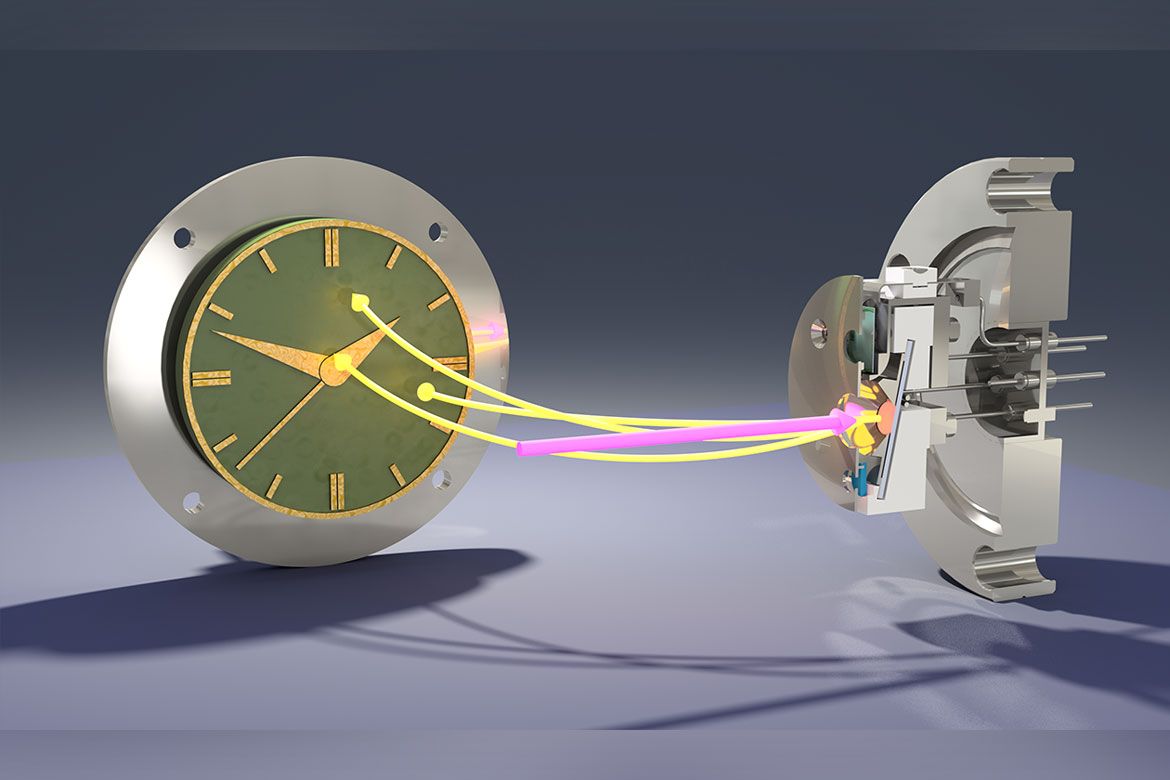
The image shows a laser (purple arrow) illuminating the electrodeposited thorium (orange) and the electrons (yellow arrows) hitting a detector (the detector front face is made to look like a clock as an artistic liberty).
<関連情報>
- https://newsroom.ucla.edu/releases/thorium-could-power-next-generation-atomic-clocks
- https://www.nature.com/articles/s41586-025-09776-4
- https://journals.aps.org/prl/abstract/10.1103/PhysRevLett.133.013201
229 ThO 2のレーザー変換電子メスバウアー分光法 Laser-based conversion electron Mössbauer spectroscopy of 229ThO2
Ricky Elwell,James E. S. Terhune,Christian Schneider,Harry W. T. Morgan,Hoang Bao Tran Tan,Udeshika C. Perera,Daniel A. Rehn,Marisa C. Alfonso,Lars von der Wense,Benedict Seiferle,Kevin Scharl,Peter G. Thirolf,Andrei Derevianko & Eric R. Hudson
Nature Published:10 December 2025
DOI:https://doi.org/10.1038/s41586-025-09776-4
Abstract
The exceptionally low-energy 229Th nuclear isomeric state is expected to provide several new and powerful applications1,2, including the construction of a robust and portable solid-state nuclear clock3, perhaps contributing to a redefinition of the second4, exploration of nuclear superradiance5,6 and tests of fundamental physics7,8,9,10. Further, analogous to the capabilities of traditional Mössbauer spectroscopy, the sensitivity of the nucleus to its environment can be used to realize laser Mössbauer spectroscopy and, with it, new types of strain and temperature sensors3,11 and a new probe of the solid-state environment12,13, all with excellent sensitivity. However, current models for examining the nuclear transition in a solid require the use of a high-bandgap, vacuum ultraviolet (VUV) transmissive host, severely limiting the applicability of these techniques. Here we report the first, to the authors’ knowledge, demonstration of laser-induced conversion electron Mössbauer spectroscopy (CEMS) of the 229Th isomer in a thin ThO2 sample whose bandgap (approximately 6 eV) is considerably smaller than the nuclear isomeric state energy (8.4 eV). Unlike fluorescence spectroscopy of the 229Th isomeric transition, this technique is compatible with materials whose bandgap is less than the nuclear transition energy, opening a wider class of systems to study and the potential of a conversion-electron-based nuclear clock.
レーザー励起229Th固体ホストにおける核異性体遷移 Laser Excitation of the 229Th Nuclear Isomeric Transition in a Solid-State Host
R. Elwell, Christian Schneider, Justin Jeet, J. E. S. Terhune, H. W. T. Morgan, A. N. Alexandrova, H. B. Tran Tan, Andrei Derevianko, and Eric R. Hudson
Physical Review Letters Published: 2 July, 2024
DOI: https://doi.org/10.1103/PhysRevLett.133.013201
Abstract
LiSrAlF6 crystals doped with 229Th are used in a laser-based search for the nuclear isomeric transition. Two spectroscopic features near the nuclear transition energy are observed. The first is a broad excitation feature that produces redshifted fluorescence that decays with a timescale of a few seconds. The second is a narrow, laser-linewidth-limited spectral feature at 148.382 19(4)stat(20)sys nm [2020 407.3(5)stat(30)sys GHz] that decays with a lifetime of 568(13)stat(20)sys s. This feature is assigned to the excitation of the 229Th nuclear isomeric state, whose energy is found to be 8.355 733(2)stat(10)sys eV in 229Th:LiSrAlF6.