2025-12-01 ノースカロライナ州立大学(NCState)
<関連情報>
- https://news.ncsu.edu/2025/12/crop-pests-can-develop-fighter-jet-wings-after-eating-specific-mix-of-corn/
- https://academic.oup.com/ee/advance-article/doi/10.1093/ee/nvaf117/8328228
Btトウモロコシで選抜されたオオタバコガは、長距離飛行に適した羽の形をしている Helicoverpa zea selected on Bt corn have wing shapes better suited to long distance flight
Katarina M Mikac, Jose H Dominguez Davila, Meagan J Powley, Sarah Barclay, Daniela Pezzini, Dominic D Reisig
Environmental Entomology Published:19 November 2025
DOI:https://doi.org/10.1093/ee/nvaf117
Abstract
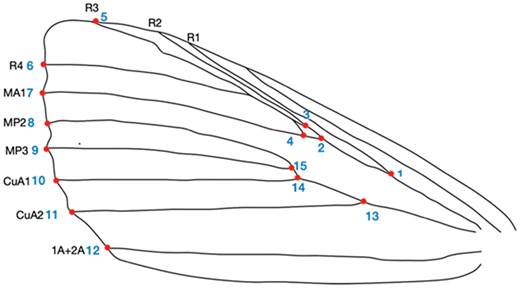
Evolution of resistance within insects to pest control has resulted in changes to the organism’s morphotype, including changes in wing shape. Both geometric morphometric and finite element method (FEM) were used to examine wing changes in Helicoverpa zea sampled from 4 different Bt corn treatments in North and South Carolina, United States. The 4 treatments were pure-stand non-Bt corn (treatment 1); pure-stand Bt corn with 2 toxins (Cry1Ab and Cry1F; treatment 2); pure-stand Bt corn with 3 toxins (Cry1Ab, Cry1F, and Vip3A; treatment 3); and seed blended Bt corn with 80% containing 3 toxins (Cry1AB, Cry1F, and Vip3A) and 20% having no toxins (treatment 5). Geometric morphometric analyses revealed significant wing shape differences in both female and male moths were driven by moderately selected moths (treatments 2 and 5). Male and female moths, especially from treatment 5, had longer and more slender forewing shape conducive for longer distance flight. FEM modeling of the flight potential in both male and female H. zea revealed that the highest wing elastic deformation values for wind speed, indicating the most impact on wing structure, occurred for treatment 2> treatment 1> treatment 3> treatment 5. Wing elastic deformation was significantly more pronounced in female than male moths. In conclusion, we found that one generation of selection on Bt corn in the field could induce H. zea wing phenotypes more conducive for potential long-distance dispersal and should be further investigated by directly testing the impact on migratory flight. Our study contributes to the growing body of evidence that selection of H. zea on Bt crops may influence adult dispersal behavior.