2025-11-14 大阪大学
国際共同研究チームは、気球搭載型硬X線偏光望遠鏡 XL-Calibur を用いて、地球から約7,000光年のブラックホール連星 はくちょう座X-1 を高感度観測し、ブラックホールへ落ち込むプラズマ(コロナ)の立体構造を世界で初めて明確に示した。日本製の世界最大級X線集光ミラーにより従来より約20倍高い感度を達成し、15–60 keVの硬X線偏光度を高精度測定。その結果、直径125 kmのブラックホール中心から約2,000 km以内に広がる扁平なコロナが、数十億 kmに伸びるプラズマジェットと垂直に整列していることが判明した。これは、円盤に沿った形状をもつコロナの存在を強く示し、ブラックホール近傍の物質流動や相対論的効果の理解を大きく前進させる成果である。
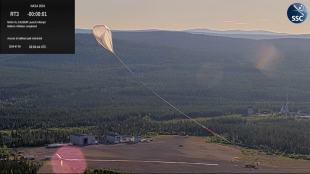
2024年7月9日にスウェーデンから放球されたXL-Calibur(エックスエル-カリバー)気球(YouTube動画「NASA XL-CALIBUR Launch」)
<関連情報>
- https://www.sci.osaka-u.ac.jp/ja/topics/15980/
- https://www.sci.osaka-u.ac.jp/ja/wp-content/uploads/2020/08/pr_matsumoto.pdf
- https://iopscience.iop.org/article/10.3847/1538-4357/ae0f1d
XL-CaliburによるCyg X-1の偏光測定により、その硬X線放射の起源がさらに限定される XL-Calibur Polarimetry of Cyg X-1 Further Constrains the Origin of Its Hard-state X-Ray Emission
Hisamitsu Awaki, Matthew G. Baring, Richard Bose, Jacob Casey, Sohee Chun, Adrika Dasgupta, Pavel Galchenko, Ephraim Gau, Kazuho Goya, Tomohiro Hakamata,…
The Astrophysical Journal Published: 2025 November 13
DOI:10.3847/1538-4357/ae0f1d
Abstract
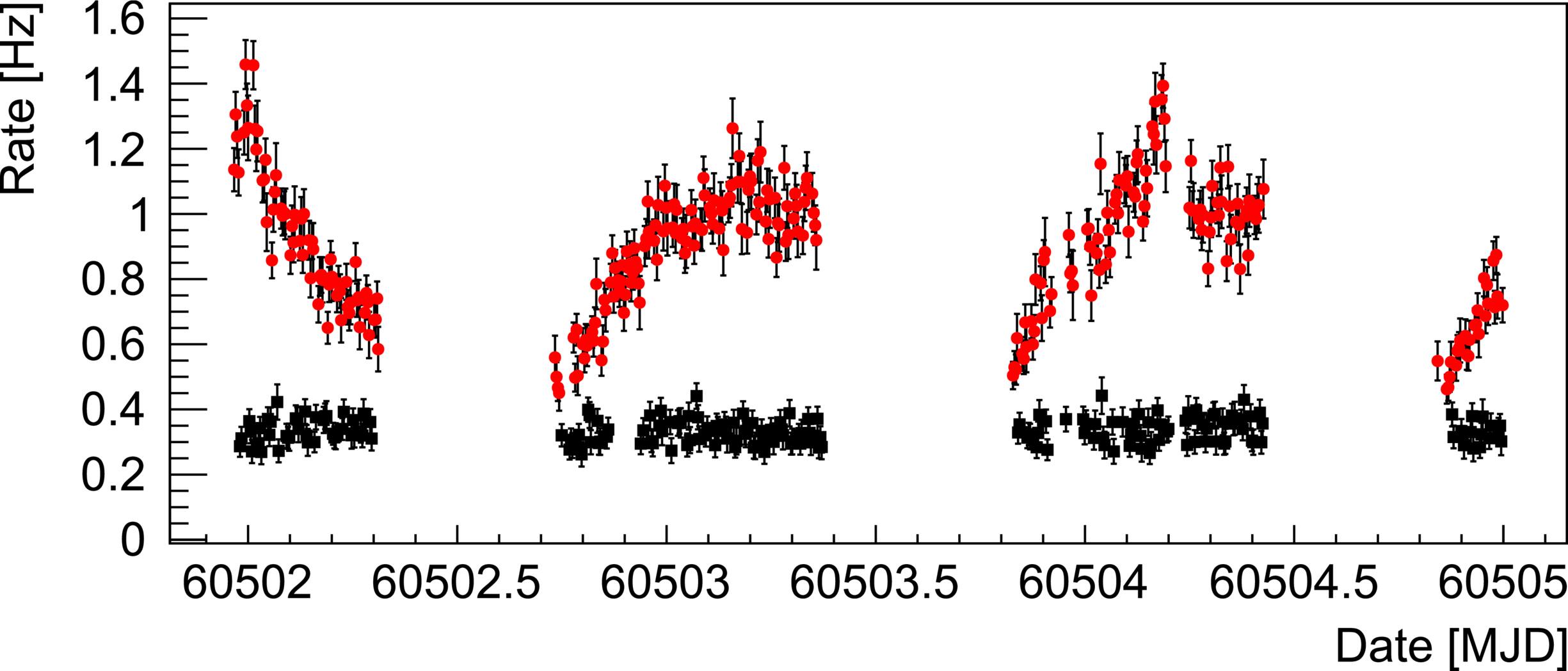
The balloon-borne hard X-ray polarimetry mission XL-Calibur observed the black hole X-ray binary (BHXRB) Cygnus X-1 (Cyg X-1) during its nearly 6 day long-duration balloon flight from Sweden to Canada in 2024 July. The XL-Calibur observations allowed us to derive the most precise constraints to date of the polarization degree (PD) and polarization angle (PA) of the hard X-ray emission from a BHXRB. XL-Calibur observed Cyg X-1 in the hard state and measured a ∼19–64 keV PD of (5.0+2.7-3.0)% (equivalent to an upper limit, at the 99% level, of 11.1%) at a PA of −28° ± 17°, with an 8.7% chance probability of detecting larger PDs than the one observed, given an unpolarized signal. The XL-Calibur results are thus comparable to the 2–8 keV PD and PA found by Imaging X-ray Polarimetry Explorer (IXPE), with a similar agreement between the hard X-ray PA and the radio jet direction. We also discuss the implications of our polarization measurements in the context of models describing the origin of the broadband X-ray and γ-ray emission, to which XL-Calibur provides independent constraints on any proposed emission modeling.