2025-11-12 ハーバード大学
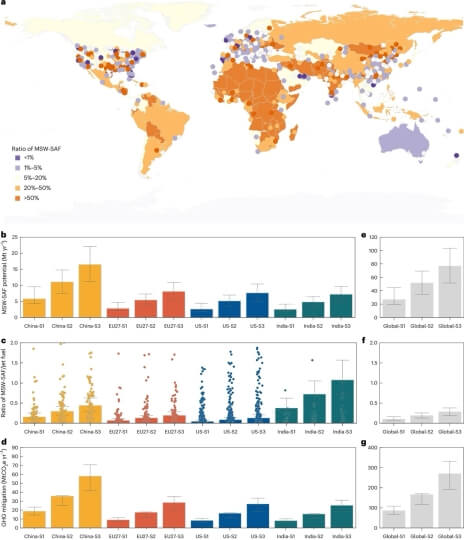
Municipal solid waste-based sustainable aviation fuel potential and its contribution to jet fuel demand across regions and scenarios.
<関連情報>
- https://seas.harvard.edu/news/2025/11/next-frontier-clean-flight-jet-fuel-city-waste
- https://www.nature.com/articles/s41893-025-01644-3
都市固形廃棄物由来のジェット燃料で航空旅行を活性化 Powering air travel with jet fuel derived from municipal solid waste
Jingran Zhang,Fang Wang,Zhao Jia Ting,Weiguo Dong,Shaojun Zhang,Ye Wu,Chris P. Nielsen,Ming Zhao,Jiming Hao & Michael B. McElroy
Nature Sustainability Published:03 November 2025
DOI:https://doi.org/10.1038/s41893-025-01644-3
Abstract
Sustainable aviation fuel (SAF) is a promising decarbonization solution for aviation, but its adoption remains below 1% due to high cost. As municipal solid waste (MSW) continues to grow and sustainable disposal remains challenging, converting MSW into SAF offers an attractive pathway to align the goals of zero-waste cities and carbon-neutral aviation, given its reliable availability, low emissions and low cost. Here we evaluate MSW as feedstock for SAF production via industrial-scale gasification and Fischer–Tropsch synthesis data. The life cycle assessment indicates that MSW-based SAF can reduce greenhouse gas intensity by 80–90% compared with conventional jet fuel, with gasification being the primary technical challenge. Incorporating green hydrogen further enhances mitigation, reducing emissions by up to 50% and enabling a reduction of over 170 kg of CO2 per tonne of processed MSW. Globally, MSW-based SAF production could exceed 50 Mt yr−1 (62.5 billion litres), offering a 16% reduction in aviation greenhouse gas emissions. In Europe, the estimated 5.4 Mt yr−1 SAF capacity from this study exceeds the European Union blending mandate and complies with its restriction to non-food and feed feedstocks. Economic analysis indicates that using SAF to meet Carbon Offsetting and Reduction Scheme for International Aviation (CORSIA) targets can lead to substantial cost savings, particularly when subsidies are available.