2025-09-17 国立環境研究所
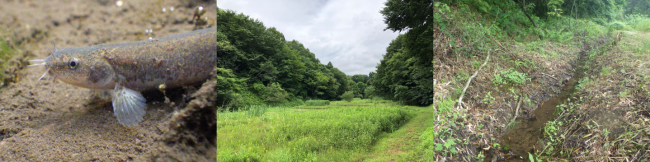
図1.ホトケドジョウ(左)。耕作放棄された谷津の様子(中)と、湧水が作る湿地(土水路)(右)。
<関連情報>
- https://www.nies.go.jp/whatsnew/2025/20250917/20250917.html
- https://esj-journals.onlinelibrary.wiley.com/doi/10.1111/1440-1703.70003
集水域内の土地利用は、生息地の適合性と春季に依存する動物の分布に影響を与える Land use within a catchment affects habitat suitability and the distribution of a spring-dependent animal
Yuna Hirano, Noe Matsushima, Natsuko I. Kondo, Hiroki Kato, Hiroshi C. Ito, Jun Nishihiro
Ecological Research Published: 09 September 2025
DOI:https://doi.org/10.1111/1440-1703.70003
Abstract
To conserve wetland biodiversity, conservation plans must consider both local environmental factors and catchment-scale factors that influence groundwater cycles. Spring-dependent animals are particularly sensitive to groundwater conditions, and land-use changes associated with urbanization can affect factors such as the temperature and stability of groundwater supply. This study aimed to examine how catchment-scale land use influences the distribution patterns of a spring-dependent animal. To explore this, we constructed a generalized linear model (GLM) incorporating both indirect influences from catchment land use and direct effects from local wetland environmental factors. Furthermore, to provide an example of conservation planning that considers land use, we assessed habitat suitability at the wetland level using a GLM and at the grid level using maximum entropy modeling (MaxEnt) with only landscape variables. Distribution data of Lefua echigonia, an indicator species of spring-dependent animals, were collected through field surveys and environmental DNA analyses in 102 first-order valleys of the Lake Inba watershed. The GLM results indicated that an index of spring water stability, the percentage of permeable surfaces in the catchment, precipitation, the period of rice paddy abandonment in the valley bottom, and valley length (representing habitat size) positively influenced the fish’s presence, while summer temperature had a negative effect. The MaxEnt analysis also showed a positive effect of the percentage of permeable surfaces. Our results highlight that both land use within a catchment and catchment size, which can affect the volume and stability of spring water, are important factors for conserving suitable habitats for spring-dependent animals.