2025-10-28 国立天文台
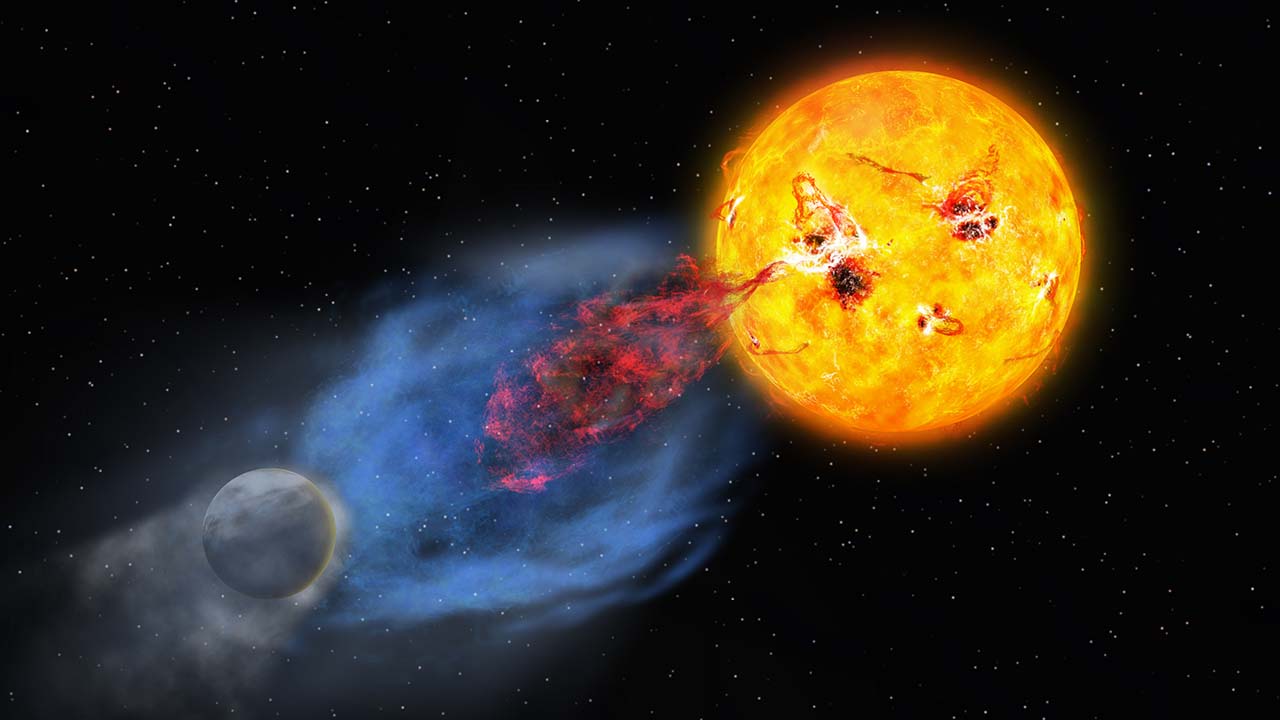
りゅう座EK星のフレアに伴うガス噴出の想像図。高温で速い噴出が青く、低温でゆっくりした噴出が赤く描かれている。(クレジット:国立天文台) 画像(2.2MB)
<関連情報>
- https://www.nao.ac.jp/news/science/2025/20251028-okayama.html
- https://www.nature.com/articles/s41550-025-02691-8
- https://iopscience.iop.org/article/10.3847/1538-4357/adfe70
若い太陽類似体からの多温度コロナ質量放出の兆候の発見 Discovery of multi-temperature coronal mass ejection signatures from a young solar analogue
Kosuke Namekata,Kevin France,Jongchul Chae,Vladimir S. Airapetian,Adam Kowalski,Yuta Notsu,Peter R. Young,Satoshi Honda,Soosang Kang,Juhyung Kang,Kyeore Lee,Hiroyuki Maehara,Kyoung-Sun Lee,Cole Tamburri,Tomohito Ohshima,Masaki Takayama & Kazunari Shibata
Nature Astronomy Published:27 October 2025
DOI:https://doi.org/10.1038/s41550-025-02691-8
Abstract
Coronal mass ejections (CMEs) on the early Sun may have profoundly influenced the planetary atmospheres of early Solar System planets. Flaring young solar analogues serve as excellent proxies for probing the plasma environment of the young Sun, yet their CMEs remain poorly understood. Here we report the detection of multi-wavelength Doppler shifts of the far-ultraviolet and optical lines during a flare on the young solar analogue EK Draconis. During and before a Carrington-class (~1032 erg) flare, warm far-ultraviolet lines (~105 K) exhibited blueshifted emission at 300–550 km s−1, indicative of a warm eruption. Then, 10 min later, the Hα line showed slow (70 km s−1), long-lasting (≳2 h) blueshifted absorptions, indicating a cool (~104 K) filament eruption. This provides evidence of the multi-temperature and multi-component nature of a stellar CME. If Carrington-class flares or CMEs occurred frequently on the young Sun, they may have cumulatively impacted the early Earth’s magnetosphere and atmosphere.
若い恒星は頻繁に大質量CMEを生成するのか?EKドラコニスとV889ヘルクレス座の5年間の専用光学観測の結果 Do Young Suns Produce Frequent, Massive CMEs? Results from Five-year Dedicated Optical Observations of EK Draconis and V889 Hercules
Kosuke Namekata, Hiroyuki Maehara, Yuta Notsu, Satoshi Honda, Kai Ikuta, Daisaku Nogami, and Kazunari Shibata
The Astrophysical Journal Published: 2025 October 27
DOI:10.3847/1538-4357/adfe70
Abstract
We report results from a five-year (132-night) dedicated observational campaign targeting two nearby young solar-type stars, EK Draconis (∼50–125 Myr age) and V889 Hercules (∼30 Myr age), using the 3.8 m Seimei Telescope and Transiting Exoplanet Survey Satellite. The aim is to observationally constrain statistical properties of flaring radiation/heating, as well as coronal mass ejections (CMEs), through high time-cadence Hα spectroscopy. We obtained an unprecedented sample of 15 Hα superflares, including two blueshifted absorption, two blueshifted emission, one redshifted emission, and nine line broadening events. We obtain the following results: (1) larger flares exhibit broader Hα line widths, up to 14.1±2.4 Å, indicating higher chromospheric heating than solar flares; (2) the long-lasting redshifted event at ∼100 km s−1 may indicate dense postflare loops; (3) Hα blueshifted absorptions/emissions provide evidence of massive filament/prominence eruptions, the core structures of CMEs. One newly identified event showed an unexpected rapid decrease in velocity; (4) the lower limit of the CME/eruption association rate with superflares is 27+25 -16%, yielding occurrence rates of 0.21±0.12 and <0.32+0.46-0.32 events per day for EK Draconis and V889 Hercules, respectively; and (5) we derived the first direct estimate of the lower limit of the mass-loss rate driven by super-CMEs (≳1033 erg) for EK Dra as 4 × (10−13–10−12) M⊙ yr−1, comparable to the stellar wind mass loss at a similar age. This study provides critical observational constraints on the radiation and plasma environment around young solar-type stars and the early Sun, which can drive planetary space weather and stellar mass/angular momentum loss.