2025-10-14 北海道大学
Web要約 の発言:
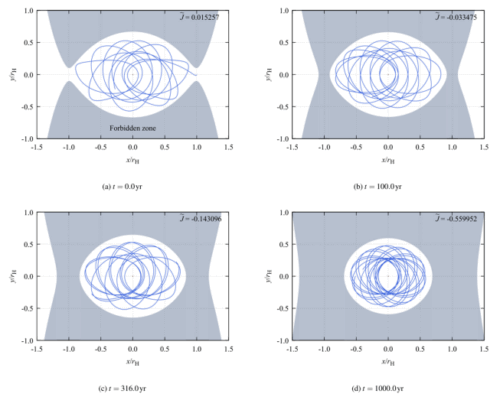
図 1. ⼩天体が⼀時捕獲状態から完全捕獲状態へと⾄る様⼦。
<関連情報>
- https://www.hokudai.ac.jp/news/2025/10/post-2086.html
- https://www.hokudai.ac.jp/news/pdf/251014_pr2.pdf
- https://academic.oup.com/mnras/article/543/3/2613/8253618
フォボスとディモスの起源:一時捕獲天体のガス抵抗捕獲 Origin of Phobos and Deimos: gas-drag capture of temporarily captured bodies
Ryo N Matsuoka, Kiyoshi Kuramoto
Monthly Notices of the Royal Astronomical Society Published:13 September 2025
DOI:https://doi.org/10.1093/mnras/staf1534
ABSTRACT
The gas-drag capture hypothesis for the origin of the Martian moons Phobos and Deimos, fairly consistent with their reflectance spectra like carbonaceous meteorites, faces difficulties in explaining their small orbital inclinations and the dense gas required for capture. Here, we show through numerical and theoretical analysis that gas-drag capture via temporary capture of small bodies can overcome these difficulties. Temporary capture occurs for small bodies entering the Martian Hill sphere at low speeds from the L1 or L2 Lagrange points, allowing them to orbit Mars repeatedly even without dissipation. Such a long-range orbit around Mars enables complete capture by weak gas drag under the minimum-mass solar nebula and more dilute gas densities, with minimal dependence on the specific gas flow structure. The orbital inclination with respect to the Mars orbital plane is suppressed to within a few degrees due to the quasi-conservation law of absolute angular momentum around Mars, and the periapsis immediately after complete capture ranges around several tens of Mars radii. The continuous gas drag with torque exerted by the Martian equatorial bulge can transfer captured bodies towards the primordial low-inclined moons’ orbits inferred from tidal evolution models. If the typical planetesimal masses are close to those of the Martian moons, there are numerous opportunities for complete capture through temporary capture even at late accretion stages with depleted nebula. The last population of captured bodies may have undergone the slowest gas drag-induced migration towards Mars and some of them may have survived as the present-day moons after the nebular dissipation.