
2025-10-13 オランダ・デルフト工科大学(TUDelft)
<関連情報>
- https://www.tudelft.nl/en/2025/citg/assessing-the-health-of-the-worlds-long-span-bridges-from-space
- https://www.nature.com/articles/s41467-025-64260-x
InSARの利用可能性を活用した長大橋梁の地球規模の地質災害リスク評価 Global geo-hazard risk assessment of long-span bridges enhanced with InSAR availability
Dominika Malinowska,Pietro Milillo,Cormac Reale,Chris Blenkinsopp & Giorgia Giardina
Nature Communications Published:13 October 2025
DOI:https://doi.org/10.1038/s41467-025-64260-x
Abstract
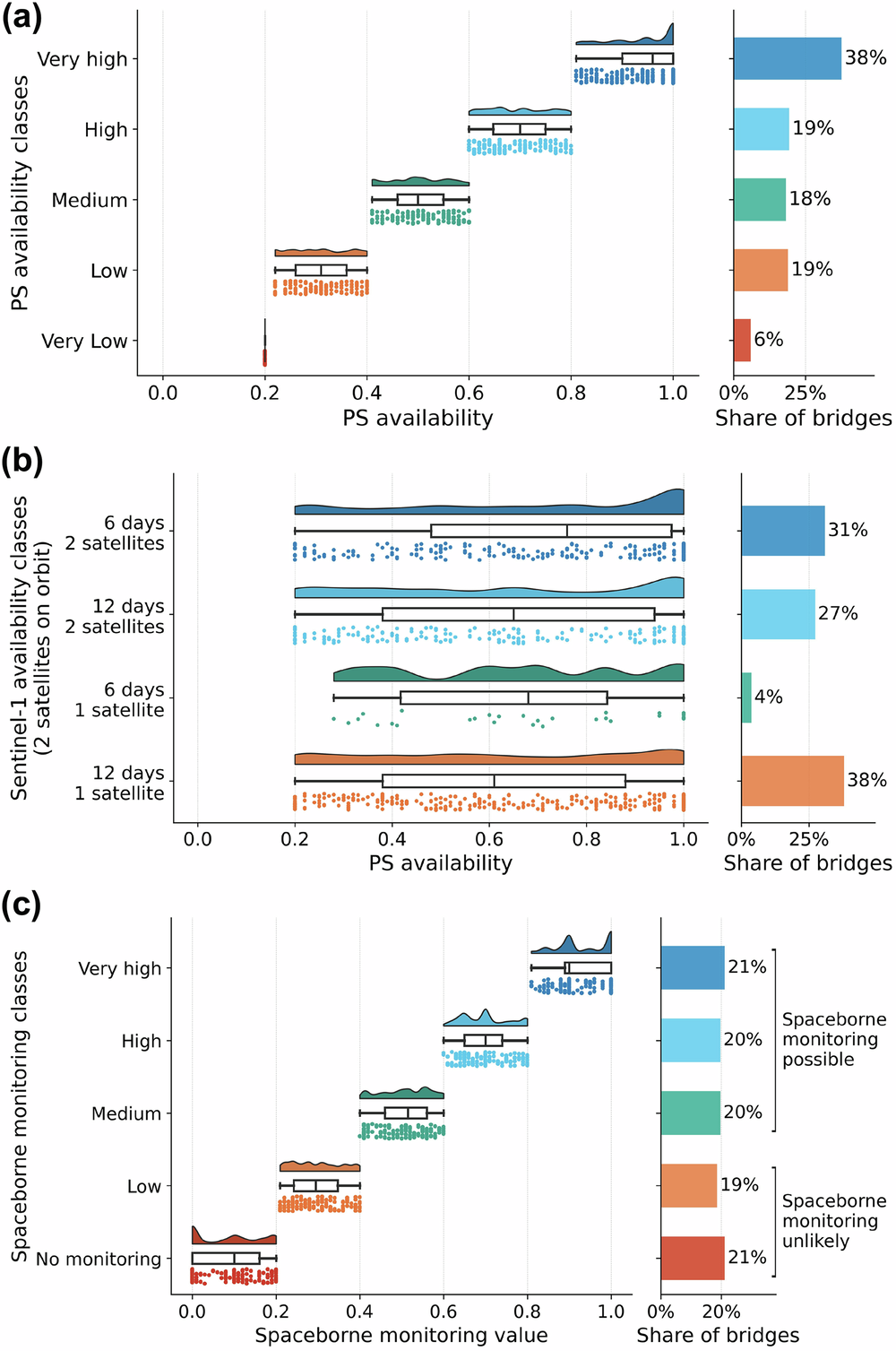
While a geo-hazard risk assessment of bridges is crucial for achieving the United Nations’ Sustainable Development Goals, state-of-the-art methods for evaluation of risk neglect the temporal dimension of structural vulnerability, overlooking how monitoring systems like Structural Health Monitoring sensors and Multi-Temporal Interferometric Synthetic Aperture Radar can continuously track bridge conditions. Moreover, despite Structural Health Monitoring systems being sparsely installed, no research has quantified the global potential of this spaceborne radar-based technique as a complementary monitoring solution for bridges. This study introduces a method that integrates monitoring availability into structural vulnerability assessments and evaluates the global risk of long-span bridges affected by subsidence and landslides. Findings revealed that while fewer than 20% of bridges have Structural Health Monitoring systems, spaceborne monitoring could provide monitoring for over 60% of structures, leveraging Sentinel-1’s global coverage. Incorporating this satellite remote sensing approach into routine assessments could decrease the number of bridges classified as high-risk by one-third. Moreover, half of the remaining high-risk structures could benefit from spaceborne monitoring, highlighting the technique’s potential to enhance structural safety and resilience, especially in economically disadvantaged regions.

