
2025-09-22 ワシントン大学セントルイス校
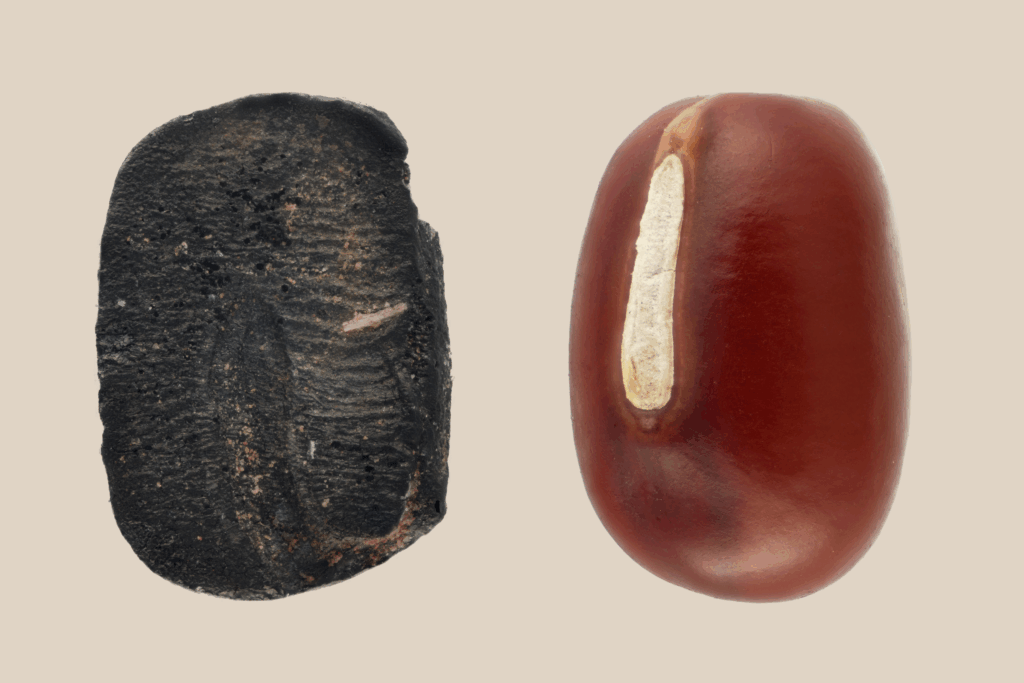
Modern adzuki bean and charred adzuki remain unearthed from Xiaogao (Image: Cai Haohong)
<関連情報>
- https://source.washu.edu/2025/09/discovery-expands-understanding-of-neolithic-agricultural-practices-diets-in-east-asia/
- https://www.pnas.org/doi/10.1073/pnas.2510835122
9千年紀前、中国東部でアズキ(Vigna angularis)が発見され、東アジアで栽培されるようになった The discovery of adzuki bean (Vigna angularis) in eastern China during the 9th millennium BP and its domestication in East Asia
Xuexiang Chen, Zejuan Sun, Shuhan Zhang, +9 , and Xinyi Liu
Proceedings of the National Academy of Sciences Published:September 22, 2025
DOI:https://doi.org/10.1073/pnas.2510835122
Significance
This discovery pushes back the timeline of adzuki bean cultivation in the Yellow River considerably, informing complex domestication pathways of a crucial legume enhancing global food security. It expands our knowledge of prehistoric farming systems in East Asia, enabling understanding of roles of dietary conditions in domestication and enriching its evidentiary basis.
Abstract
Adzuki bean (Vigna angularis) is a key legume widely cultivated in East Asia, prized for both its nutritional value and nitrogen-fixing properties. This paper presents one of the oldest directly dated archaeological finds of adzuki bean, recovered from the Xiaogao site in Shandong, China, and dated to 8985-8645 and 8032-7939 cal. BP—predating previously known Chinese records by at least 4,000 y (approximately 6,000 y considering published directly dated evidence alone). The evidence suggests that adzuki beans formed part of an Early Neolithic multicropping system alongside millet, rice, and soybean in a well-established agricultural tradition in the Lower Yellow River region. Morphometric analysis of adzuki beans from 41 archaeological sites across East Asia reveals a gradual increase in seed size over time when regional data are aggregated, yet highlights distinct regional trajectories. These patterns reflect complex, multiregional domestication processes shaped by both cultural practices and ecological conditions. Notably, the marked differences in bean sizes observed between the Neolithic Yellow River and Jomon-period Japan could be contingent on the distinctions in dietary regimes and associated selective pressures.

