2025-09-19 物質・材料研究機構,東洋炭素株式会社
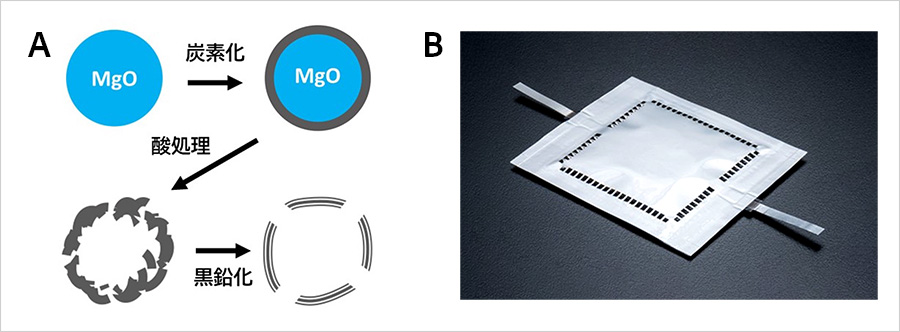
図: (A) メソスケール細孔が制御されたカーボン材料合成スキームの概念図。(B) 本研究で作製した1Wh級の積層型リチウム空気電池の外観。
<関連情報>
- https://www.nims.go.jp/press/2025/09/202509190.html
- https://www.nims.go.jp/press/2025/09/he2u5l0000008x4d-att/202509190.pdf
- https://www.cell.com/cell-reports-physical-science/fulltext/S2666-3864(25)00440-0
1ワット時級リチウム-酸素パウチ型二次電池用階層的多孔質黒鉛化炭素膜 Hierarchically porous graphitized carbon membrane for 1-Watt-hour-class rechargeable lithium-oxygen pouch cells
Arghya Dutta ∙ Takashi Kameda ∙ Emiko Mizuki ∙ … ∙ Yuuka Nakajima ∙ Takahiro Morishita ∙ Shoichi Matsuda
Cell Reports Physical Science Published:September 17, 2025
DOI:https://doi.org/10.1016/j.xcrp.2025.102841
Highlights
- Scalable fabrication of self-standing porous carbon membranes
- Interconnected macropores for better O2 transport
- Stable LOB cycling over 150 cycles at 1.5 mA cm−2 with lean electrolyte
- Multi-stacked LOB pouch cell demonstrates >1 Wh energy and long stability
Summary
Despite lithium-oxygen batteries (LOBs) achieving energy densities over 500 Watt hours (Wh) kg−1 at the cell level, challenges remain in extending cycle life, high-rate operation, and scalability. A critical limitation lies in designing carbon-based positive electrodes with optimal porosity and stability. Previous efforts with highly porous carbon materials face issues like unoptimized pore structures, excessive microporosity, low stability, and non-scalable fabrication methods, particularly under lean-electrolyte conditions. Here, we report a scalable, cost-effective approach to fabricate self-standing carbon membranes via (1) hard-templated synthesis of mesoporous carbon with reduced microporosity, (2) slurry casting using the doctor-blade method, and (3) non-solvent-induced phase separation (NIPS) to create interconnected macropores for improved oxygen transport. LOB cells employing these hierarchically porous carbon membranes and lean electrolyte demonstrated stable cycling for over 150 cycles at 1.5 mA cm−2. Additionally, a 1-Wh-class multi-stacked LOB achieved long cycling stability. This report offers a breakthrough in scalable, high-energy-density LOB electrode development.