
2025-09-18 東京大学国際高等研究所カブリ数物連携宇宙研究機構(Kavli IPMU, WPI)
Web要約 の発言:
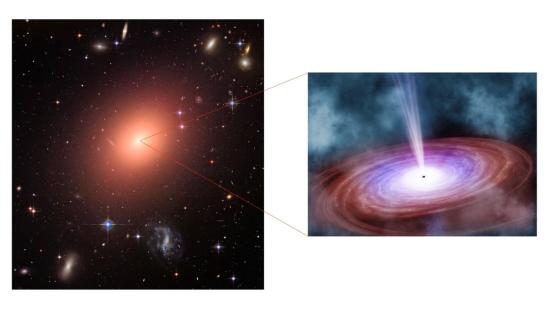
図1. 星形成活動が停止期に向かう成熟した銀河(左)と、その中心で輝くクェーサー(右)。両図とも想像図 (Credit:Kavli IPMU)
<関連情報>
z>6における巨大銀河とブラックホール形成のためのポストスターバースト経路 A post-starburst pathway for the formation of massive galaxies and black holes at z > 6
Masafusa Onoue,Xuheng Ding,John D. Silverman,Yoshiki Matsuoka,Takuma Izumi,Michael A. Strauss,Charlotte Ward,Camryn L. Phillips,Kei Ito,Irham T. Andika,Kentaro Aoki,Junya Arita,Shunsuke Baba,Rebekka Bieri,Sarah E. I. Bosman,Anna-Christina Eilers,Seiji Fujimoto,Melanie Habouzit,Zoltan Haiman,Masatoshi Imanishi,Kohei Inayoshi,Kazushi Iwasawa,Knud Jahnke,Nobunari Kashikawa,… Haowen Zhang
Nature Astronomy Published:11 August 2025
DOI:https://doi.org/10.1038/s41550-025-02628-1
Abstract
Understanding the rapid formation of supermassive black holes in the early Universe requires insights into stellar mass growth in host galaxies. Here we present NIRSpec rest-frame optical spectra and NIRCam imaging from JWST of two galaxies at z > 6, both hosting moderate-luminosity quasars. These galaxies exhibit Balmer absorption lines, like low-redshift post-starburst galaxies. Our analyses of the medium-resolution spectra and multiband photometry show that the bulk of the stellar mass (log(M*/M☉) ≥ 10.6) formed in starburst episodes at redshift 9 and 7. One of the galaxies shows a clear Balmer break and lacks spatially resolved Hα emission. It falls well below the star-formation main sequence at z = 6, indicating quiescence. The other is transitioning to quiescence; together, these massive galaxies are among the most distant post-starburst systems known. The blueshifted wings of the quasar [O iii] emission lines indicate quasar-driven outflow, which possibly influences star formation. Direct stellar velocity dispersion measurements reveal that one galaxy follows the local black hole mass versus σ* relation whereas the other is overmassive. The existence of massive post-starburst galaxies hosting billion-solar-mass black holes in short-lived quasar phases indicates that supermassive black holes and host galaxies played a principal role in each other’s rapid early formation.

