2025-08-21 中国科学院(CAS)
<関連情報>
- https://english.cas.cn/newsroom/research_news/phys/202508/t20250821_1051182.shtml
- https://iopscience.iop.org/article/10.3847/1538-4357/adec71
自己重力による球対称な蓄積:解析式と数値検証 Spherically Symmetric Accretion with Self-gravity: Analytical Formulae and Numerical Validation
Cheng-Liang Jiao (焦承亮), Er-gang Zhao, Liying Zhu, and Xiang-dong Shi
The Astrophysical Journal Published: 2025 August 6
DOI:10.3847/1538-4357/adec71
Abstract
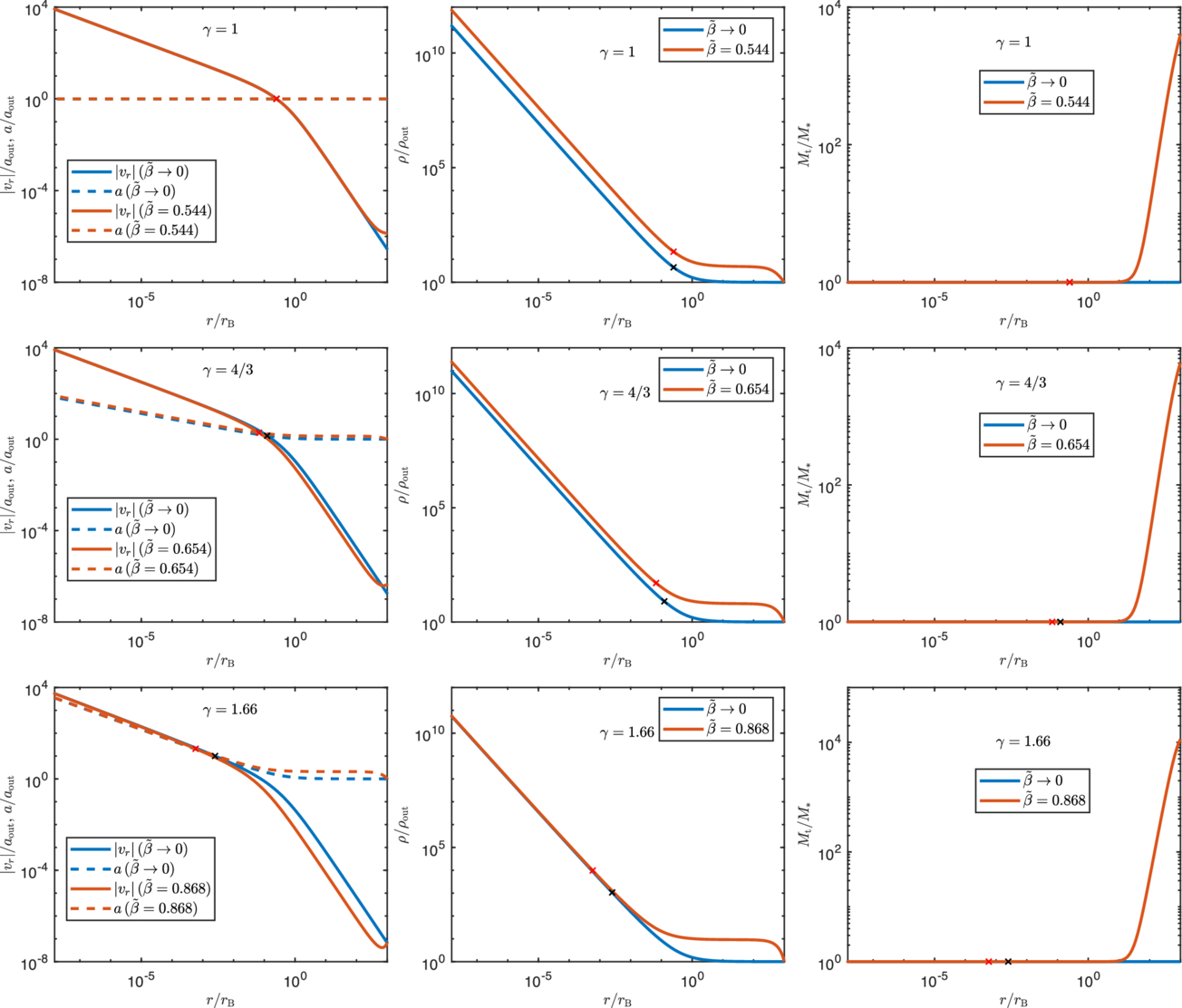
Spherically symmetric accretion incorporating self-gravity constitutes a three-point boundary value problem (TPBVP) governed by constraints at the outer boundary, sonic point, and accretor surface. Previous studies have two limitations: either employing an incorrect formula for self-gravity potential in analytical treatments, or introducing additional input parameters in numerical implementations to circumvent solving the full TPBVP. To address these issues, we present a self-consistent TPBVP formulation, solved using the relaxation method. We also derive approximate analytical formulae that enable rapid estimates of self-gravity effects. Our analysis identifies a dimensionless parameter β三2Gρ–r2out/a2out that characterizes the strength of self-gravity, p– where and rout are the mean density and outer radius of the flow, respectively, and aout is the adiabatic sound speed of the external medium. For practical estimation, p–may be approximated by the external medium density ρout. We identify an upper limit for β, beyond which steady accretion becomes unsustainable—a behavior consistent with classical gravitational instability that previous studies failed to capture. The accretion rate enhancement decreases monotonically as the adiabatic index γ increases. For γ = 5/3, self-gravity ceases to augment the accretion rate. These theoretical predictions are validated by our numerical solutions. We further apply our results to two astrophysical scenarios: hyper-Eddington accretion onto supermassive black hole seeds in the early Universe, where self-gravity is significant; and accretion onto stellar-mass objects embedded in active galactic nuclei disks, where self-gravity is non-negligible under certain conditions and should be evaluated using β.