
2025-08-22 東北大学
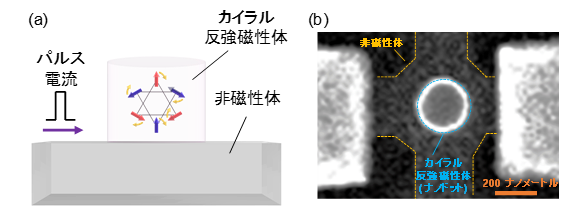
図1. (a) カイラル反強磁性体ナノドット素子の高速制御実験の模式図。(b) 今回作製したナノドット素子の観察画像。
<関連情報>
- https://www.tohoku.ac.jp/japanese/2025/08/press20250822-01-spin.html
- https://www.tohoku.ac.jp/japanese/newimg/pressimg/tohokuuniv-press20250822_01web_spin.pdf
- https://www.science.org/doi/10.1126/science.ado1611
電気的コヒーレント駆動によるキラル反強磁性体 Electrical coherent driving of chiral antiferromagnet
Yutaro Takeuchi, Yuma Sato, Yuta Yamane, Ju-Young Yoon, […] , and Shunsuke Fukami
Science Published:21 Aug 2025
DOI:https://doi.org/10.1126/science.ado1611
Editor’s summary
Antiferromagnetic spintronics hold the promise of high speed and high efficiency unachievable with ferromagnets. However, reaching these goals in experiments has proven tricky. Takeuchi et al. realized all-electrical driving of an antiferromagnetic Mn3Sn (manganese-tin) nanodot. The researchers used electric-current pulses as short as 0.1 nanoseconds at current densities insensitive to pulse width. —Jelena Stajic
Abstract
Electric current driving of antiferromagnetic states at radio or higher frequencies remains challenging to achieve. In this study, we report all-electrical, gigahertz-range coherent driving of chiral antiferromagnet manganese-tin (Mn3Sn) nanodot samples. High coherence in multiple trials and threshold current insensitive to pulse width, in contrast to results observed with ferromagnets, were achieved in subnanosecond range, allowing 1000/1000 switching by 0.1-nanosecond pulses at zero field. These features are attributed to the inertial nature of antiferromagnetic excitations. Our study highlights the potential of antiferromagnetic spintronics to combine high speed and high efficiency in magnetic device operations.

