2025-08-18 ジョージア工科大学
<関連情報>
- https://research.gatech.edu/breaking-rules-build-better-battery
- https://www.nature.com/articles/s41467-025-61813-y
高スループットのインサイトX線回折による亜鉛電極沈積における速度依存性テクスチャ成長の理解 Understanding rate-dependent textured growth in zinc electrodeposition via high-throughput in situ x-ray diffraction
Yifan Ma,Jakub Pepas,Guangxing Zhang,Zhaonan Liu,Yang Su,Jianming Bai,Hui Zhong,Tianyi Li,Wenqian Xu,Minju Kang,John Carsley,Josh Kacher & Hailong Chen
Nature Communications Published:12 August 2025
DOI:https://doi.org/10.1038/s41467-025-61813-y
Abstract
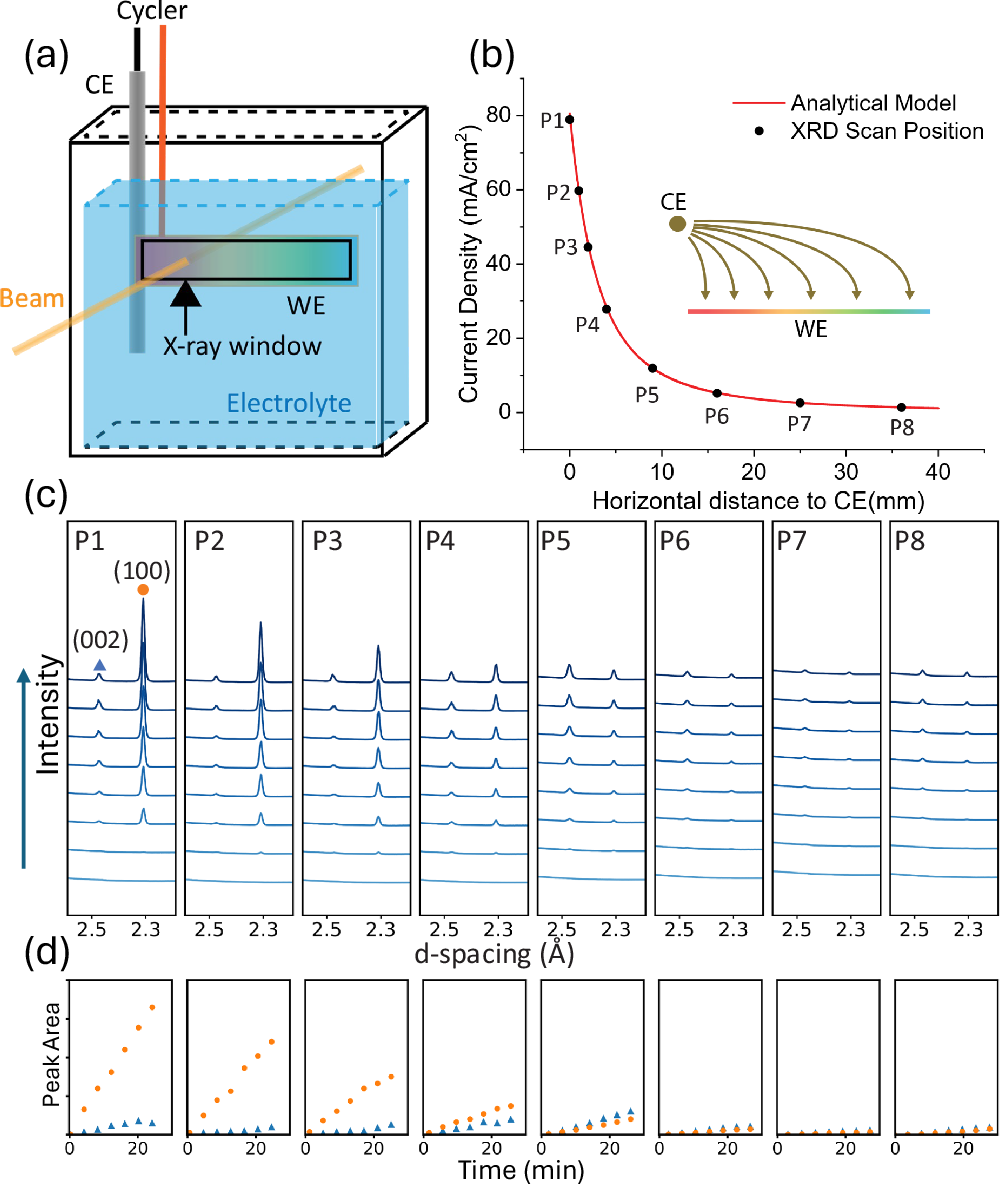
Zn-ion batteries with aqueous electrolytes are promising for large-scale energy storage as they are low-cost, environment-friendly and safe. The commercialization of Zn-ion batteries is hindered by several challenges such as the formation of detrimental Zn dendrites. High current density is previously thought to stimulate the dendritic growth of metals such as Li in electrodeposition. However, our study finds that for metallic Zn negative electrode in Zn-ion batteries, high-current deposition results in a dense and flat Zn layer with a (002) texture, which extends the cycling life. Low-current deposition, on the other hand, leads to a porous and dendritic morphology and a short cycling life. Using a synchrotron-based high-throughput in situ X-ray diffraction method we recently developed, Zn deposition under different conditions is systematically investigated, and a texture formation mechanism is proposed. Based on these findings, we suggest guidelines for designing cycling protocols that enable long-lasting Zn-ion batteries.