2025-08-19 東京科学大学
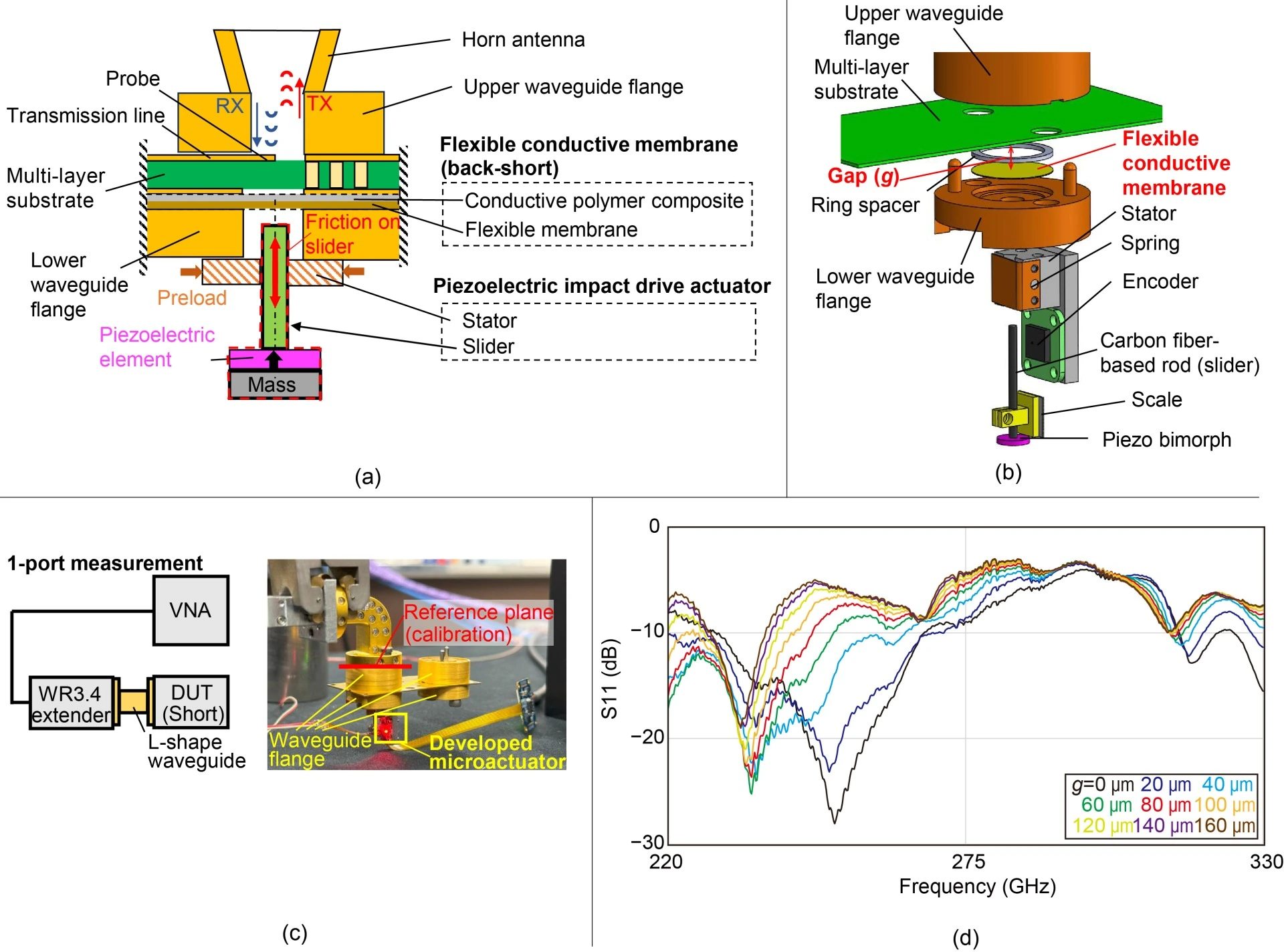 図1. (a) 提案するフレキシブル導電性メンブレン・マイクロアクチュエータを用いたインピーダンス可変型変換部の概略図と(b) 3Dモデル。(c) 1ポート(ショートパターン)測定のためのベクトルネットワークアナライザ(VNA)およびWR3.4周波数拡張器を用いた反射特性測定システムの構成とそのスナップショット。(d) ショートパターンに対してギャップ(g)を変化させながら測定したフランジ部(レファレンス面)での反射特性(S11)。
<関連情報>
- https://www.isct.ac.jp/ja/news/zvk0j6c8l37w
- https://www.isct.ac.jp/plugins/cms/component_download_file.php?type=2&pageId=&contentsId=1&contentsDataId=2070&prevId=&key=feebedac9d1bc1f4de850ad1204c72de.pdf
- https://ieeexplore.ieee.org/document/11052303
マイクロアクチュエーターと柔軟な導電性膜を用いた249 GHzインピーダンス調整可能波導管移行 A 249-GHz Impedance-Tunable Waveguide Transition Using a Microactuator and Flexible Conductive Membrane
Chao Qi; Sangyeop Lee; Takeshi Yoshida; Tadahiko Shinshi
IEEE Access Published:26 June 2025
DOI:https://doi.org/10.1109/ACCESS.2025.3583279
Abstract
A terahertz band (e.g., 150 GHz/300 GHz), with its broad bandwidth and potential for improved angular and distance resolution, is attracting attention for Beyond 5G/6G communication and sensing applications (radar, imager, etc.). However, as frequencies increase and wavelengths shorten, mechanical tolerances during integration can significantly impact performance (reflection, transmission, etc.), necessitating effective compensation mechanisms. In this paper, we verify the performance variations caused by mechanical tolerances in transmission-line-to-waveguide transitions, which integrate chips, substrates, and waveguides to transmit signals generated by the chip or receive signals from external sources. To overcome these challenges, a tunable-membrane microactuator is proposed, which adjusts the position of the back-short in the transition by using a flexible conductive membrane and a microactuator (dimension: ϕ10 mm ×16 mm, maximum stroke of the membrane: 707.7 μ m, accuracy<1 μ m). The proposed waveguide transition comprises a transmission line and a probe integrated on the multi-layer substrate, along with waveguide flanges and the tunable membrane microactuator. Based on simulation and measurement results, this paper demonstrates the capability of the proposed technology to tune the reflection/transmission losses and frequency bandwidth characteristics of a 249-GHz waveguide transition.