2025-07-29 京都大学
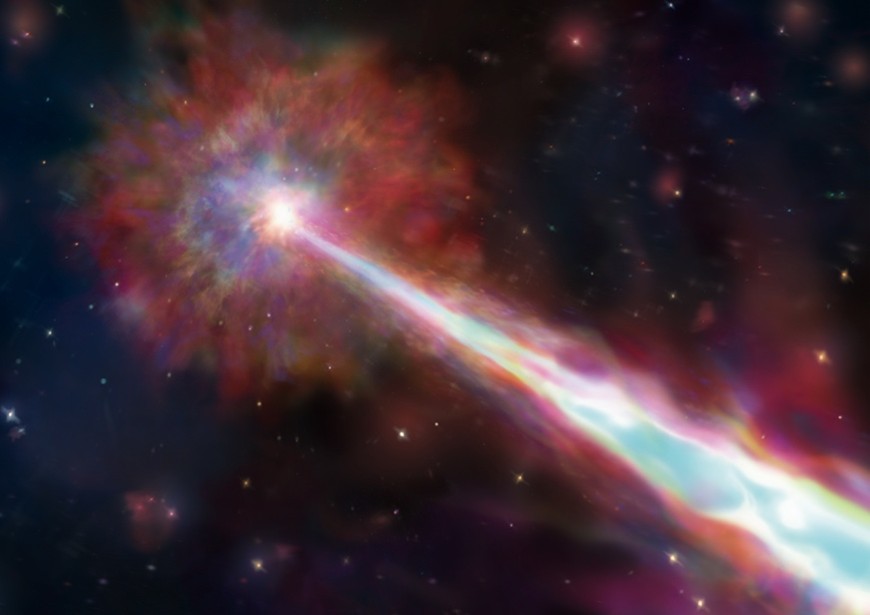
ガンマ線バーストの想像図:中心のエンジンであるブラックホールから超高速の粒子流「ジェット」が吹き出ている様子。(Credit:東京大学宇宙線研究所/若林菜穂)
<関連情報>
- https://www.kyoto-u.ac.jp/ja/research-news/2025-07-29-1
- https://www.kyoto-u.ac.jp/sites/default/files/2025-07/web_2507_Ioka-c5bf8493243d1cf8d9658a6ff7dc6ecd.pdf
- https://iopscience.iop.org/article/10.3847/2041-8213/ade4cf
GRB 221009A:CTAOのLST-1による観測と長ガンマ線バーストにおける構造化ジェットへの示唆 GRB 221009A: Observations with LST-1 of CTAO and Implications for Structured Jets in Long Gamma-Ray Bursts
K. Abe, S. Abe, A. Abhishek, F. Acero, A. Aguasca-Cabot, I. Agudo, C. Alispach, D. Ambrosino, F. Ambrosino, L. A. Antonelli,…
The Astrophysical Journal Letters Published: 2025 July 23
DOI:10.3847/2041-8213/ade4cf
Abstract
GRB 221009A is the brightest gamma-ray burst (GRB) observed to date. Extensive observations of its afterglow emission across the electromagnetic spectrum were performed, providing the first strong evidence of a jet with a nontrivial angular structure in a long GRB. We carried out an extensive observation campaign in very-high-energy (VHE) gamma rays with the first Large-Sized Telescope of the future Cherenkov Telescope Array Observatory starting on 2022 October 10, about 1 day after the burst. A dedicated analysis of the GRB 221009A data is performed to account for the different moonlight conditions under which data were recorded. We find an excess of gamma-like events with a statistical significance of 4.1σ during the observations taken 1.33 days after the burst, followed by background-compatible results for the later days. The results are compared with various models of afterglows from structured jets that are consistent with the published multiwavelength data but entail significant quantitative and qualitative differences in the VHE emission after 1 day. We disfavor models that imply VHE flux at 1 day considerably above 10−11 erg cm−2 s−1. Our late-time VHE observations can help disentangle the degeneracy among the models and provide valuable new insight into the structure of GRB jets.