2025-04-09 アメリカ合衆国・バージニア大学 (UVA)
<関連情報>
- https://engineering.virginia.edu/news-events/news/cooler-faster-better-uva-engineers-uncover-new-way-stop-electronics-overheating
- https://www.nature.com/articles/s41563-025-02154-5
六方晶窒化ホウ素における双曲線型フォノン・ポラリトンモードを介した固体界面間の超高速減衰熱伝達 Ultrafast evanescent heat transfer across solid interfaces via hyperbolic phonon–polariton modes in hexagonal boron nitride
William Hutchins,Saman Zare,Dan M. Hirt,John A. Tomko,Joseph R. Matson,Katja Diaz-Granados,Mackey Long III,Mingze He,Thomas Pfeifer,Jiahan Li,James H. Edgar,Jon-Paul Maria,Joshua D. Caldwell & Patrick E. Hopkins
Nature Materials Published:17 March 2025
DOI:https://doi.org/10.1038/s41563-025-02154-5
Abstract
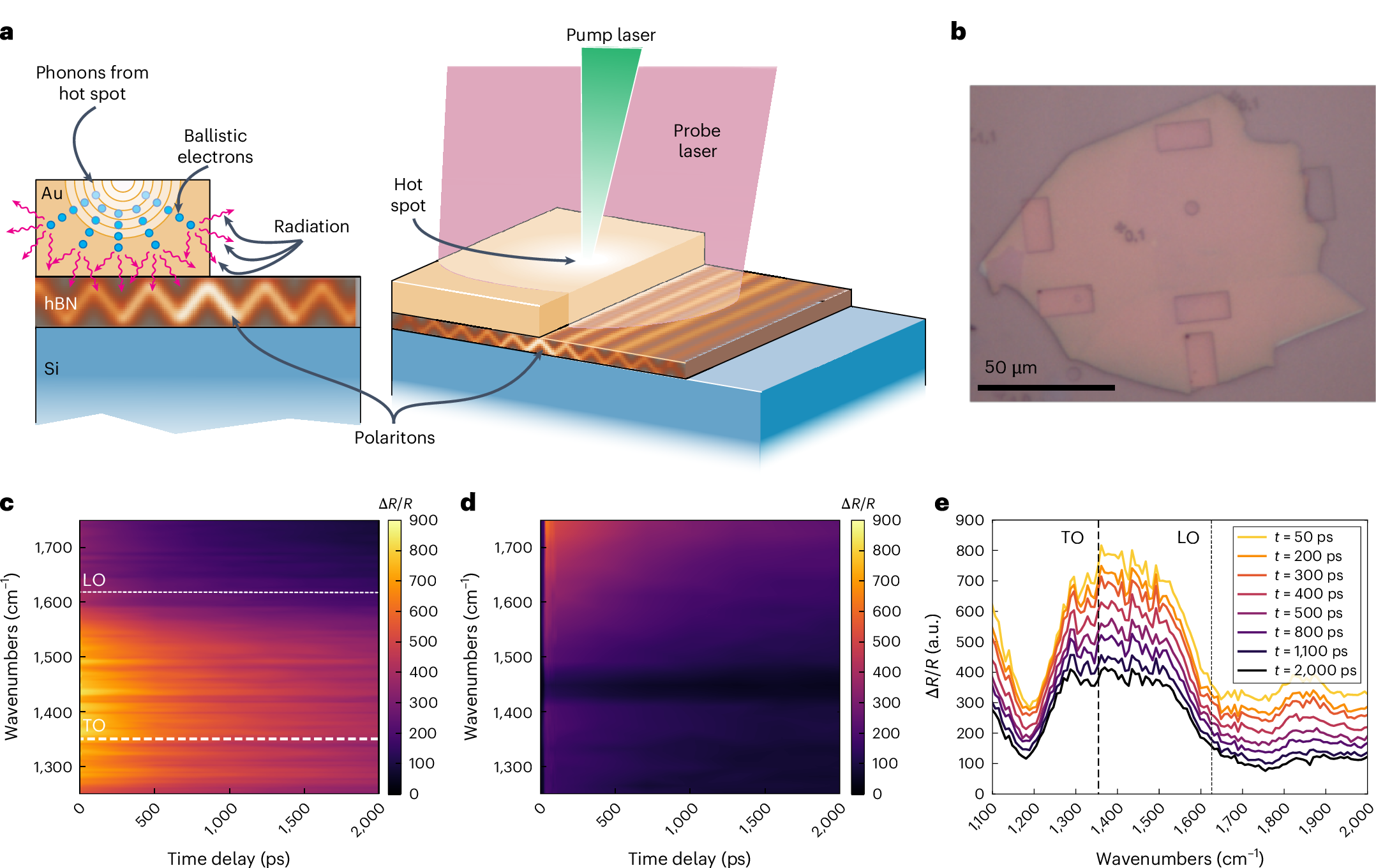
Thermal transport across solid–solid interfaces is vital for advanced electronic and photonic applications, yet conventional conduction pathways often restrict performance. In polar crystals, hybridized vibrational modes called phonon polaritons offer a promising avenue to overcome the limitations of intrinsic phonon heat conduction. Here our work demonstrates that volume-confined hyperbolic phonon polariton (HPhP) modes can transfer energy across solid–solid interfaces at rates far exceeding phonon–phonon conduction. Using pump–probe thermoreflectance with a mid-infrared, tunable probe pulse with subpicosecond resolution, we remotely and selectively observe HPhP modes in hexagonal boron nitride (hBN) via broadband radiative heating from a gold source. Our measurements ascertain that hot electrons impinging at the interface radiate directly into the HPhPs of hBN in the near field, bypassing the phonon–phonon transport pathway. Such polaritonic coupling enables thermal transport speeds in solids orders of magnitude faster than possible through diffusive phonon processes. We thereby showcase a pronounced thermal transport enhancement across the gold–hBN interface via phonon–polariton coupling, advancing the limits of interfacial heat transfer.