2025-07-17 スイス連邦工科大学ローザンヌ校(EPFL)
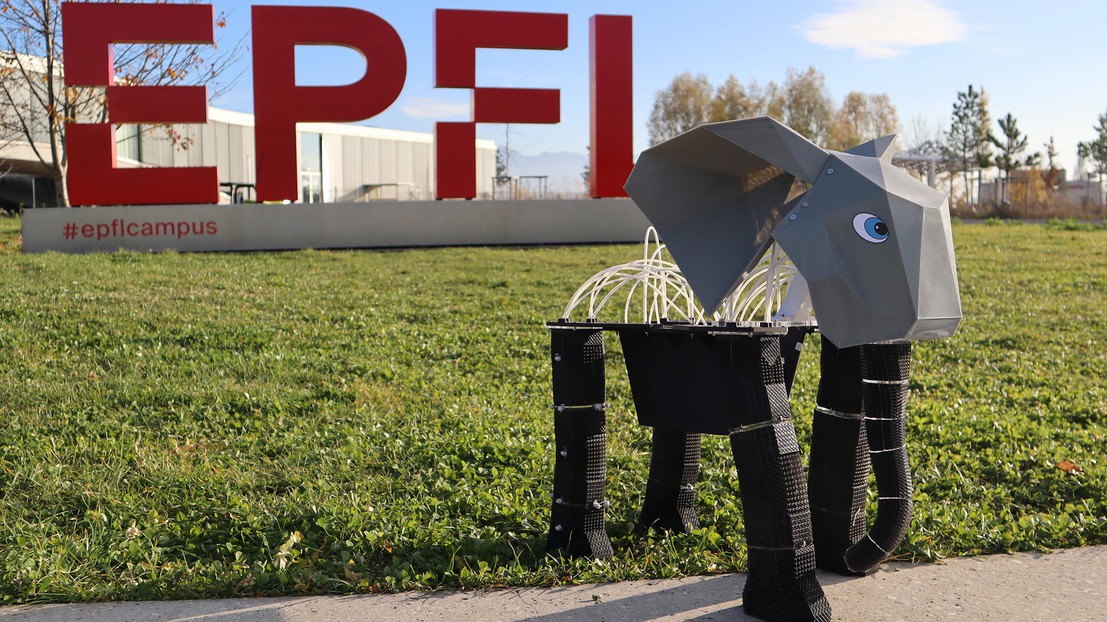
The EleBot. 2025 CREATE EPFL CC BY SA 4.0
<関連情報>
- https://actu.epfl.ch/news/elephant-robot-demonstrates-bioinspired-3d-print-2/
- https://www.science.org/doi/10.1126/sciadv.adu9856
格子構造の筋骨格ロボット:プログラム可能な幾何学的トポロジーと異方性を利用する Lattice structure musculoskeletal robots: Harnessing programmable geometric topology and anisotropy
Qinghua Guan, Benhui Dai, Hung Hon Cheng, and Josie Hughes
Science Advances Published:16 Jul 2025
DOI:https://doi.org/10.1126/sciadv.adu9856
Abstract
Natural musculoskeletal systems combine soft tissues and rigid structures to achieve diverse mechanical behaviors that are both adaptive and precise. Inspired by these systems, we propose a programming method for designing bioinspired soft-rigid robotic structures using lattice geometries made from a single material. By introducing previously unknown approaches to the geometric design of unit cells within lattice structures—based on continuous blending and superposition of existing lattice geometries—we can precisely tune stiffness and anisotropy. These designs enable the creation of three-dimensional structures with spatially varying mechanical properties, ranging from tissue-like compliance to rigid, bone-like load-bearing capabilities. Using these methods, we fabricated a musculoskeletal-inspired tendon-driven robotic elephant that integrates joints with programmable bending profiles, achieving a continuously soft trunk. Our lattice geometry generation techniques allow for over 1 million discrete configurations and infinite geometric variations, offering a scalable solution for designing lightweight, adaptable robots.