2025-07-03 中国科学院(CAS)
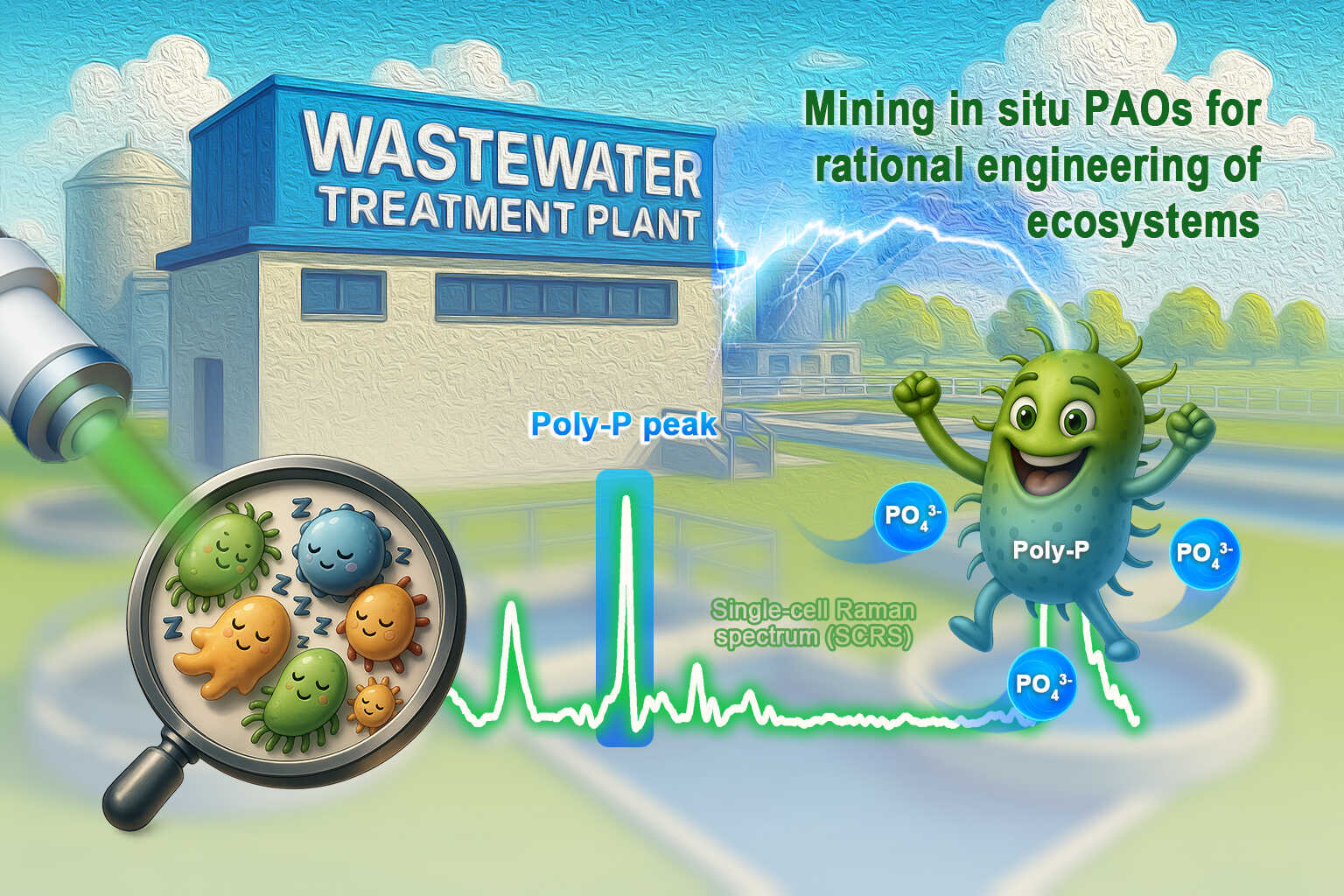 IMSCA platform uncovers “hidden champions” among a microbiota, dramatically enhancing phosphorus removal in wastewater. (Image by QIBEBT)
<関連情報>
- https://english.cas.cn/newsroom/research_news/life/202507/t20250703_1046709.shtml
- https://www.sciencedirect.com/science/article/abs/pii/S0043135425009339?via%3Dihub
シングルセルRACS-Cultureを用いた合理的な生態系工学のための強固なリン蓄積性生物のin situ探索 Mining robust in situ phosphorus-accumulating organisms via single-cell RACS-Culture for rational ecosystem engineering
Xiaoyan Jing, Yanhai Gong, Yishang Ren, Liyan Wang, Runzhi Mu, Pengcheng Sun, Zhidian Diao, Yu Meng, Liming Huang, Xixian Wang, Jia Zhang, Jiaxuan Luan, Yuetong Ji, Bo Ma, Huihui Pan, Yushu Jing, Jian Xu
Water Research Available online: 14 June 2025
DOI:https://doi.org/10.1016/j.watres.2025.124025
Highlights
- Developed the IMSCA strategy to identify and cultivate robust in situ PAOs from environmental samples.
- Identified Micrococcus luteum MCI5–8 as a novel PAO with unique features: no anaerobic phosphate release, glycogen-based energy storage, and lack of denitrification.
- Demonstrated enhanced phosphorus removal efficiency from 45 % to 89 % in an AAO reactor upon introducing M. luteum MCI5–8.
- Provided a broadly applicable framework for functional microbial screening and rational ecosystem engineering in environmental and industrial contexts.
Abstract
Rational engineering of ecosystems is often hindered by the inability to rapidly identify, profile, culture and apply the microbes that underlie target metabolic activity in situ. Here, we developed an In-situ Metabolism driven Sorting, Culture and Augmentation (IMSCA) strategy via Raman-activated Cell Sorting coupled to single-cell culture (scRACS-Culture), and demonstrated it through the mining of in situ polyphosphate-accumulating organisms (PAOs) for wastewater treatment. Single-cell polyphosphate-accumulating activities in situ were quantitatively assessed directly from environmental samples via the polyphosphate band in Raman spectrum, revealing their remarkable distinction from those from pure cultures. Among cells with the highest in situ activities and then sorted for one-cell-one-well cultivation are Micrococcus luteum CI5–8, which however shows very low activity as pure culture. This organism represents a new type of PAO due to its lack of anaerobic phosphate release, reliance on glycogen instead of polyhydroxyalkanoate as energy storage form, and incapability of denitrification. Process redesign based on these novel physiological traits showed that time- and location-specific introduction of MCI5–8 into actual wastewater elevated phosphorus (P) removal efficiency from 45 % to 89 % in an anaerobic-anoxic-aerobic (AAO) reactor. Therefore, by label-free profiling, sorting and cultivation of individual cells based on in situ metabolism in a “screen-first culture-second” manner, IMSCA is a powerful and broadly applicable strategy for efficient bioresource mining and rational ecosystem engineering.