2026-04-02 東京大学
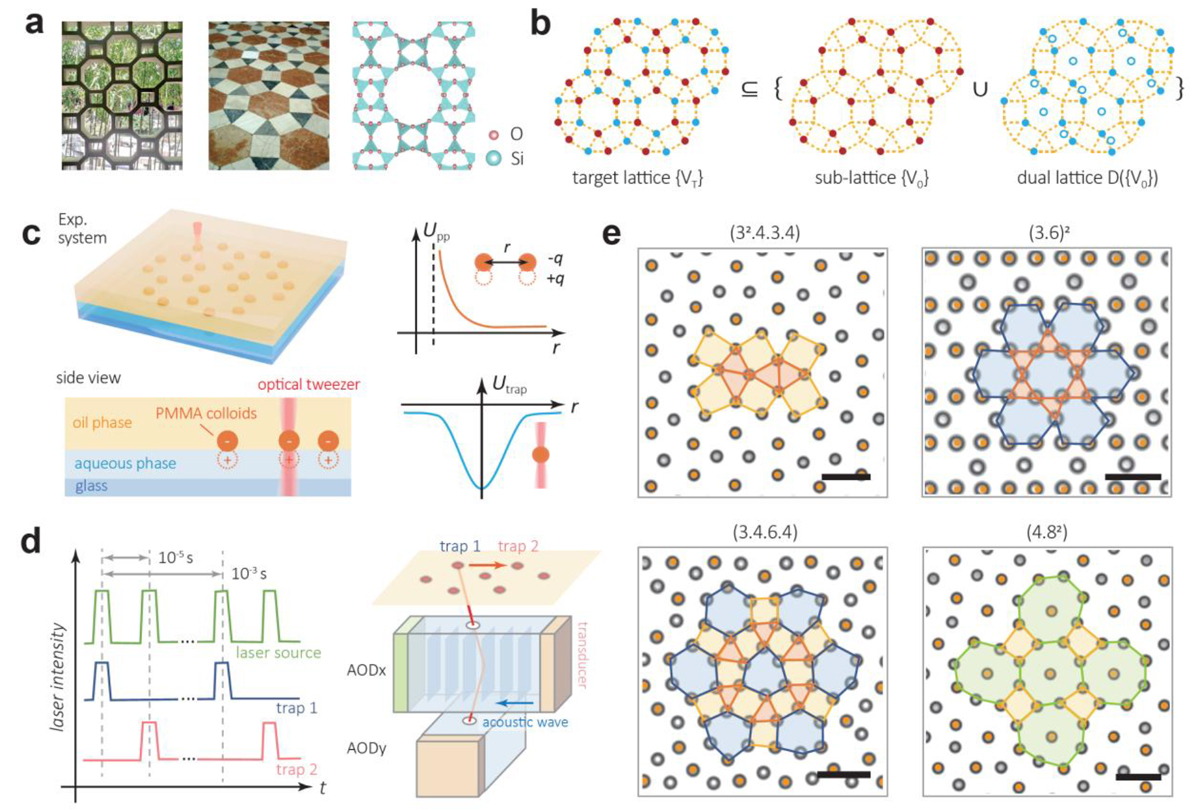
図1:コロイド実験による双対対称性誘導(DSG)法の実装。
<関連情報>
- https://www.rcast.u-tokyo.ac.jp/ja/news/release/20260402.html
- https://www.nature.com/articles/s41586-026-10364-3
二重対称性を利用した複雑な格子構造の構築 Dual-symmetry-guided assembly of complex lattices
Huang Fang,Xiaotian Li,Wensi Sun,Chengxin Wang,Nuo Chen,Yining Gan,Jiping Huang,Yuqiang Ma,Hajime Tanaka & Peng Tan
Nature Published:01 April 2026
DOI:https://doi.org/10.1038/s41586-026-10364-3
Abstract
Complex lattices that combine low- and high-order rotational symmetries underpin functional materials ranging from kagome superconductors1,2,3 to auxetic mechanical networks4 and photonic crystals with topologically protected states5,6,7. However, assembling such structures typically requires anisotropic particle shapes, directional bonding or fully imposed templates8,9,10,11, which often suffer from severe kinetic frustration and defect trapping. Here we introduce a dual-symmetry-guided (DSG) principle that exploits the geometric self-duality of a target tiling. By decomposing the structure into two mutually dual sublattices of lower symmetry and sparsely pinning only one sublattice using optical traps in a colloidal monolayer, the complementary sublattice spontaneously self-organizes through purely isotropic repulsive interactions, thereby reconstructing the full lattice. Using this minimal guidance strategy, we experimentally realize, and corroborate with simulations, a broad class of complex Archimedean lattices as well as two-dimensional quasicrystalline structures. DSG reveals lattice-dependent thermal stability while preserving interconnected free volume for mobile particles, enabling efficient defect relaxation and kinetically accessible assembly even under strong pinning conditions. We show that full pinning corresponds to a special limiting case of DSG, and that reformulating conventional templating protocols within the DSG framework systematically reduces kinetic barriers and suppresses defect formation. By decoupling structural complexity from interaction anisotropy, DSG provides a general and experimentally accessible route to complex-symmetry materials with programmable structural and physical properties.