
2026-04-08 バッファロー大学(UB)
<関連情報>
- https://www.buffalo.edu/news/releases/2026/04/penguin-toxicologists-find-forever-chemicals.html
- https://www.sciltp.com/journals/eesus/articles/2603003293
パーフルオロアルキル物質(PFAS)モニタリングにおけるペンギンの指標種としての活用:非侵襲的ツールとしてのシリコーンパッシブサンプラーの評価 Penguins as Sentinel Species for Monitoring Per- and Polyfluoroalkyl Substances (PFAS): Evaluation of Silicone Passive Samplers as a Non-Invasive Tool
Paige C. Montgomery,Ralph Eric Thijl Vanstreels,Luciana Gallo,Gabriela S. Blanco,Flavio R. Quintana,Marcela M. Uhart, Katarzyna Kordas,Diana S. Aga
Earth: Environmental Sustainability Published: 23 Mar 2026
DOI:https://doi.org/10.53941/eesus.2026.100009
Abstract
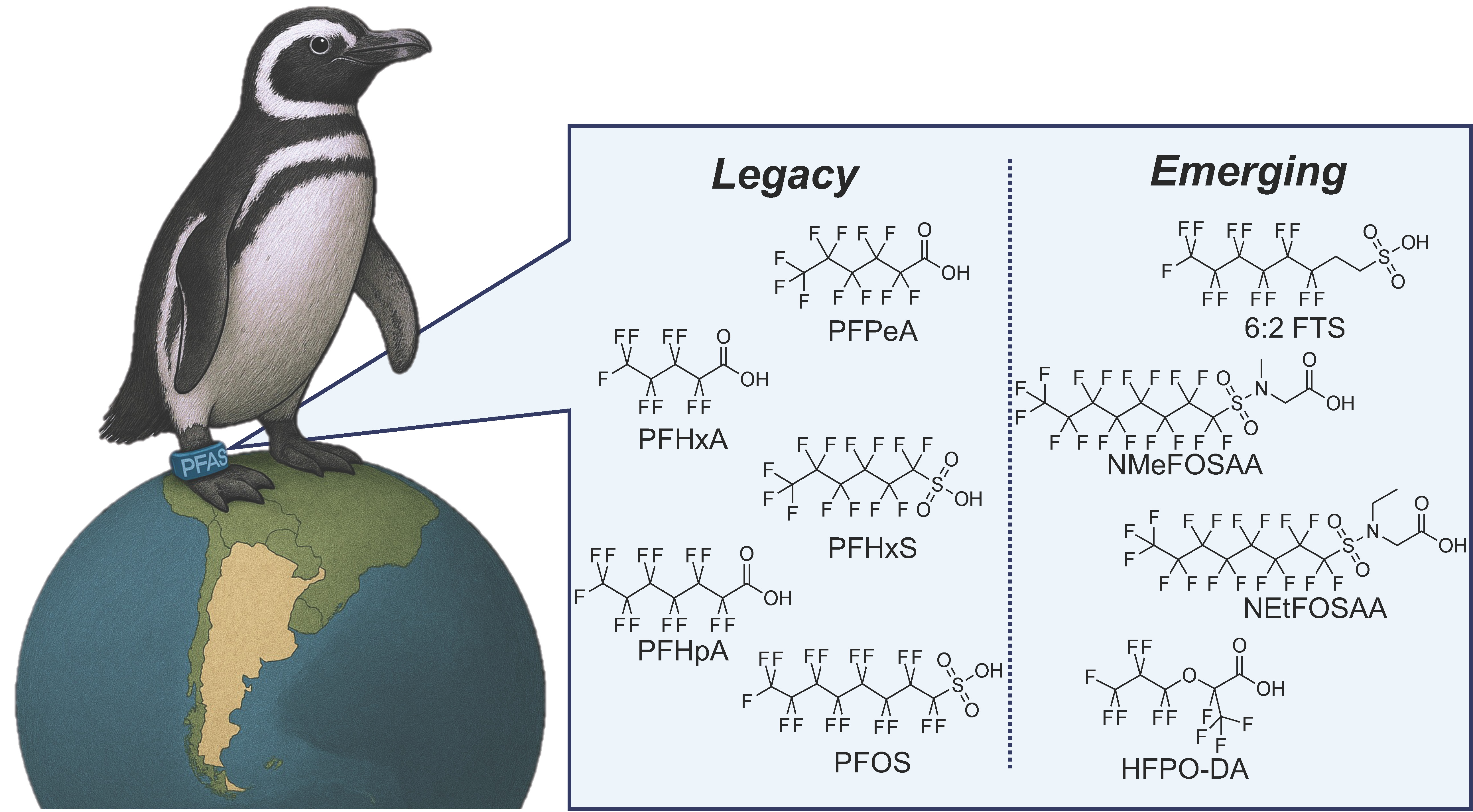
Per- and polyfluoroalkyl substances (PFAS) are globally distributed anthropogenic contaminants of concern due to their environmental persistence, bioaccumulation potential, and adverse health effects. Despite increasing recognition of PFAS exposure in marine wildlife, data for penguins remain limited, in part due to challenges associated with traditional sampling methods. We present a proof-of-concept application of silicone passive samplers (SPS) as a minimally invasive approach to characterize contact-based environmental PFAS exposure in penguins. SPS bands (n = 55) were deployed (2–9 days) on Magellanic penguins (Spheniscus magellanicus) at two colonies along the Patagonian coast of Argentina across three consecutive breeding seasons. Forty PFAS were targeted and quantified using liquid chromatography-tandem mass spectrometry (LC-MS/MS). PFAS were detected on the vast majority (90.7%) of SPS bands, with a mean ΣPFAS concentration of 2.26 ± 2.46 ng/g (maximum = 16.23 ng/g). Five legacy (PFPeA, PFHxA, PFHxS, PFHpA, and PFOS) and four emerging compounds (HFPO-DA, 6:2 FTS, NMeFOSAA, and NEtFOSAA) were identified. The frequency and/or concentration of PFPeA, PFHxA, PFHpA, HFPO-DA, and 6:2 FTS varied significantly among colony-season cohorts, while PFHxA, 6:2 FTS, and NMeFOSAA varied significantly with the duration of the deployment period. SPS bands provide a minimally invasive, repeatable, and practical approach for comparing relative external exposure profiles of penguins, and they could be adapted for other sensitive species to improve our understanding of PFAS and contaminant exposure in wildlife. Future studies should pair SPS deployments with biological matrices (e.g., blood) to determine how SPS-derived profiles relate to internal biological burdens and to validate the interpretation of SPS measurements.


