2026-04-08 東京科学大学
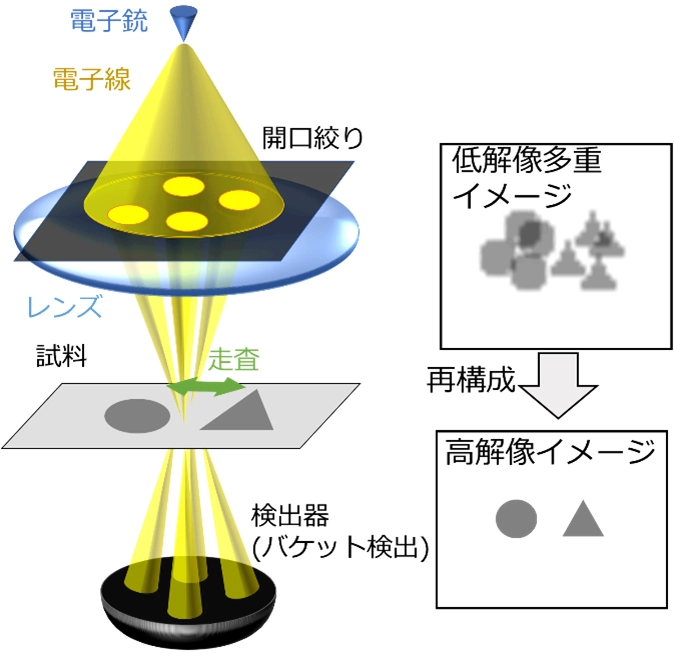
図1. マルチビームを用いた走査透過電子顕微鏡法の模式図
<関連情報>
- https://www.isct.ac.jp/ja/news/repj9l2p3kke#top
- https://www.sciencedirect.com/science/article/pii/S030439912600046X
圧縮型マルチビーム走査透過型電子顕微鏡 Compressive multi-beam scanning transmission electron microscopy
Akira Yasuhara, Takumi Sannomiya, Ryoichi Horisaki
Ultramicroscopy Available online: 15 March 2026
DOI:https://doi.org/10.1016/j.ultramic.2026.114353
Highlights
- Multi-beam STEM bright-field imaging is combined with down-sampling and super-resolution reconstruction using a compressive sensing framework.
- A custom condenser aperture with randomly distributed holes generates multibeam probes, with defocus control enabling tunable beam distribution.
- Adam optimization with total variation normalization recovers high-quality sample structures from significantly down-sampled data.
- Image quality improves when beam spots are more widely separated, emphasizing the importance of frequency sampling in sparse reconstruction.
- The bucket-detection approach is directly applicable to analytical STEM and SEM techniques such as EDS, EELS, and CL, offering substantial acceleration of data acquisition.
Abstract
We demonstrate a multi-beam scanning transmission electron microscopy (STEM) imaging that integrates down-sampling with super-resolution image reconstruction via a compressive sensing framework. A custom condenser aperture with six randomly positioned circular holes is employed to produce a multi-beam STEM probe, with the beam shape and distribution tuned through defocus. While the raw multi-beam images exhibit overlapping patterns, reconstruction using Adam optimization and total variation normalization yields high-fidelity images that closely reproduce the original sample structures, even from substantially down-sampled data. The proposed approach offers a pathway toward significant acceleration of such techniques through multibeam sparse sampling and computational reconstruction potentially useful for the analytical scanning methods in general.