2026-04-02 カリフォルニア大学リバーサイド校(UCR)
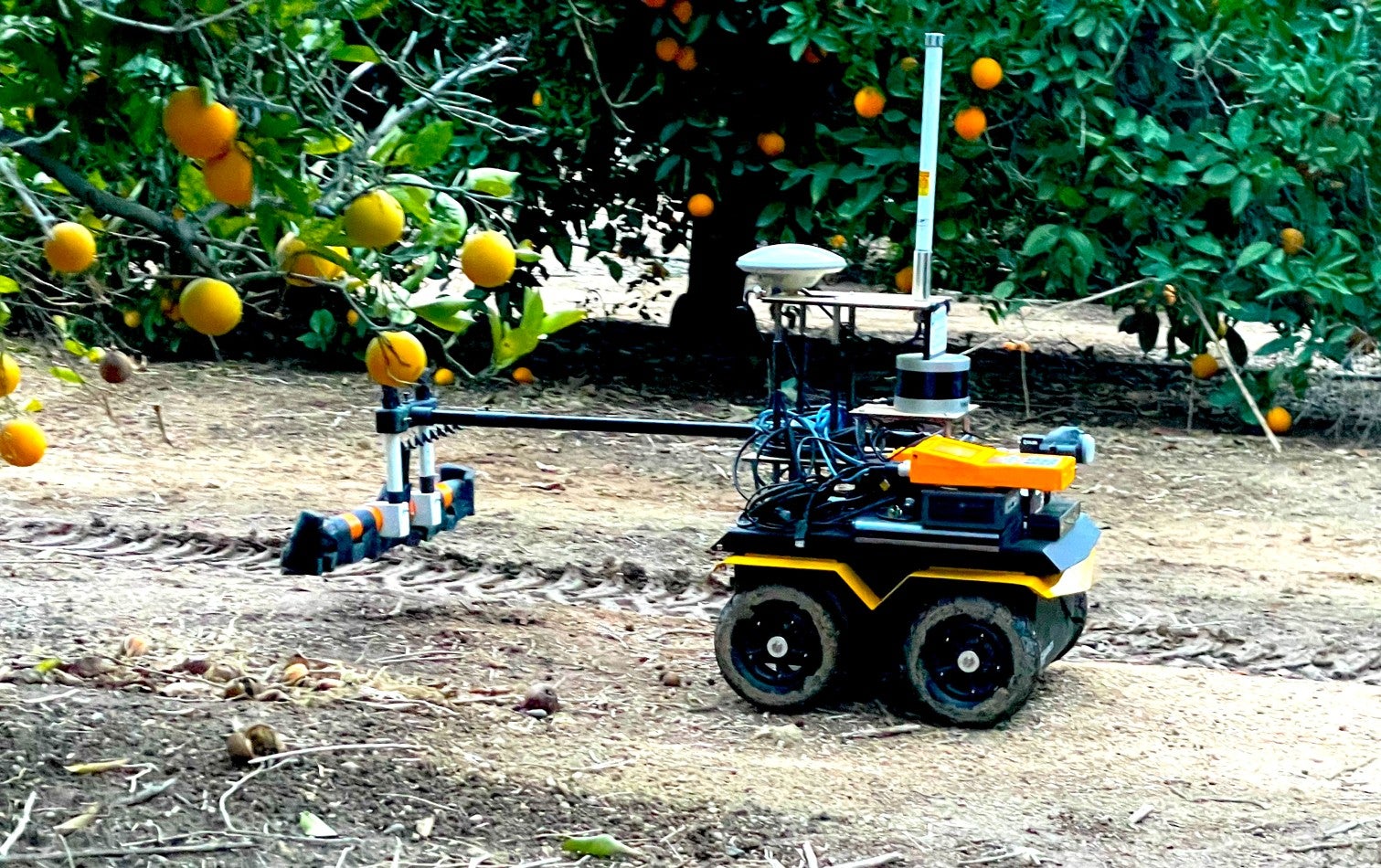
Robot assisting with precision irrigation in an orchard. (Elia Scudiero/UCR)
<関連情報>
- https://news.ucr.edu/articles/2026/04/02/watering-smarter-not-more
- https://www.sciencedirect.com/science/article/pii/S0168169926001353
カリフォルニア州のマイクロ灌漑柑橘園における土壌体積含水率のロボットマッピングと地理空間土壌見かけ電気伝導率の測定 Robotic mapping of soil volumetric water content with geospatial soil apparent electrical conductivity in micro-irrigated citrus orchards in California
Francesco Morbidini, Aritra Samanta, Carmelo Maucieri, Konstantinos Karydis, Peggy A. Mauk, Todd H. Skaggs, Elia Scudiero
Computers and Electronics in Agriculture Available online: 11 February 2026
DOI:https://doi.org/10.1016/j.compag.2026.111540
Highlights
- Robot-assisted EMI surveys mapped VWC in citrus orchards.
- ANOCOVA regression calibrated EMI data with minimal TDR ground-truth.
- Accurate VWC maps achieved with only 4 to 6 calibration footprints per field.
- Best models averaged RMSE of 0.039 m3 m−3 in independent evaluations.
- Approach supports tree-scale precision irrigation management.
Abstract
Soil moisture plays a crucial role in irrigation management and in understanding key hydrological and agronomic processes. This study investigated an innovative approach to estimate soil volumetric water content (VWC) using apparent electrical conductivity (ECa) measured by a portable electromagnetic induction (EMI) sensor mounted on a semi-autonomous ground robot. The investigation was conducted between October 2024 and March 2025, in two California citrus orchards, each surveyed four times. Geospatial EMI data were acquired across the entire fields. The VWC ground-truth measurements (0–0.12 m) were collected using a time domain reflectometry sensor (i.e., TDR-VWC) at twenty 0.5 m × 0.5 m footprints per orchard. The ECa data were calibrated to estimate TDR-VWC with analysis of covariance regression. Different model formulations were used to investigate the TDR-VWC prediction errors due to varying model inputs and size of the ground-truth sample (N = 2, 3, 4, 5, 6, 8, 10, and 12). All models were calibrated and evaluated (3 datapoints per field) 10,000 times using randomly selected calibration and evaluation datapoints. With N = 12 per field, most model formulations had median evaluation root mean square errors (RMSEs) ∼ 0.040 m3 m−3. When minimal ground-truth (N = 2) was used to calibrate the relationship between ECa and TDR-VWC, the best model had a median evaluation RMSE = 0.048 m3 m−3. Accuracy improved (RMSEs = 0.040 m3 m−3 at N = 6) with more calibration points. With N > 6 benefits became marginal. This research advanced the field of VWC sensing in precision agriculture by combining robotic ECa measurements and data driven modeling using minimal ground truth to derive accurate VWC estimations. Researchers, growers, and practitioners may employ this approach to obtain VWC maps to improve irrigation management at the orchard scale.