2026-03-31 合肥物質科学研究院(HFIPS)
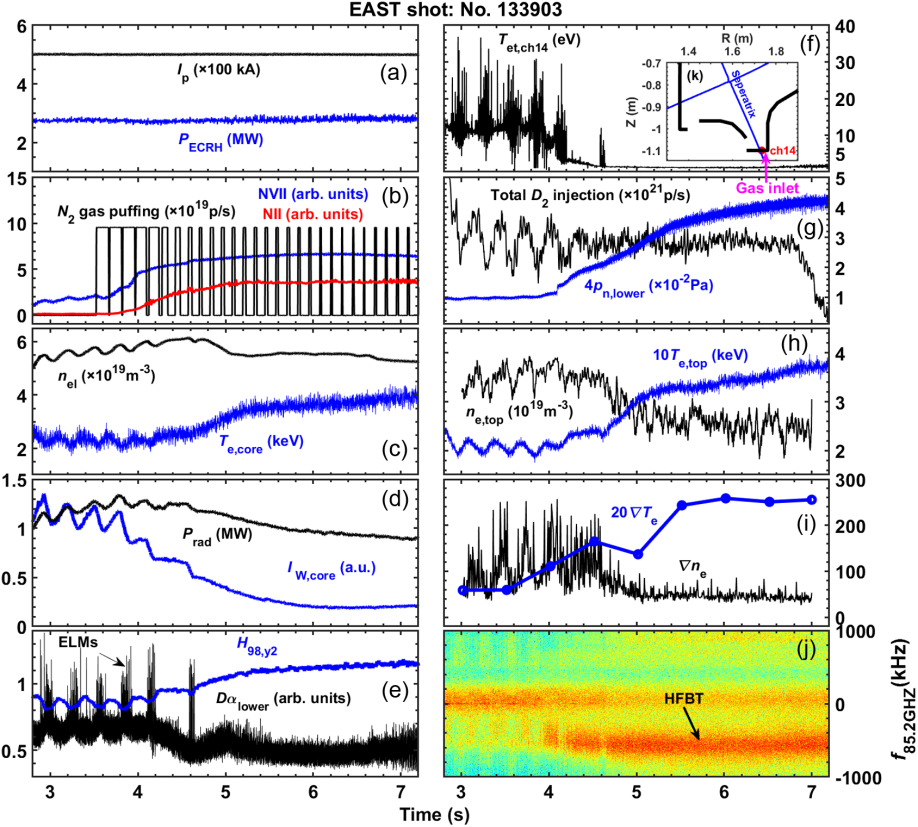
Achievement of partial divertor detachment, ELM suppression, and marked improvement in pedestal performance via light impurity injection. (Image by DING Genfan)
<関連情報>
- https://english.hf.cas.cn/nr/rn/202603/t20260331_1154298.html
- https://journals.aps.org/prl/abstract/10.1103/7r3f-dqft
金属壁トカマクにおけるダイバータ剥離を伴う乱流駆動型エッジ局在モードフリー高閉じ込めモード Turbulence-Driven Edge-Localized-Mode-Free High-Confinement Mode with Divertor Detachment in a Metal-Wall Tokamak
G. S. Xu, G. F. Ding, G. J. Zhang, Y. F. Wang, X. Jian, T. Zhang, Z. Q. Zhou,, K. Wu, Q. Q. Yang et al.
Physical Review Letters Published: 23 March, 2026
DOI: https://doi.org/10.1103/7r3f-dqft
Abstract
We report the first demonstration of a minute-scale, edge-localized-mode-free high-confinement plasma regime compatible with divertor partial detachment and enhanced pedestal performance in a metal-wall tokamak, the Experimental Advanced Superconducting Tokamak. This regime is enabled by a newly identified mechanism: during divertor partial detachment, reduced ionization and enhanced pumping in a closed divertor lead to less cooling of the pedestal by recycling neutrals and seeding impurities, resulting in an increased pedestal temperature gradient, which excites high-frequency broadband turbulence. Gyrokinetic simulations identify the high-frequency broadband turbulence as a temperature-gradient-driven trapped electron mode (ηe-TEM), which drives outward transport of particles and heat, thereby maintaining the edge-localized-mode-free state. This pedestal regime is particularly promising for the International Thermonuclear Experimental Reactor, where the anticipated lower density gradient, reduced E×B shear, and lower collisionality in the pedestal will further facilitate ηe-TEM excitation. The achieved integrated scenario with a detached divertor and turbulence-dominated pedestal thus offers a compelling solution for managing heat loads and metal impurity sources for long-pulse high-performance operation in future fusion reactors.