2026-01-26 アメリカ合衆国・ローレンスリバモア国立研究所(LLNL)

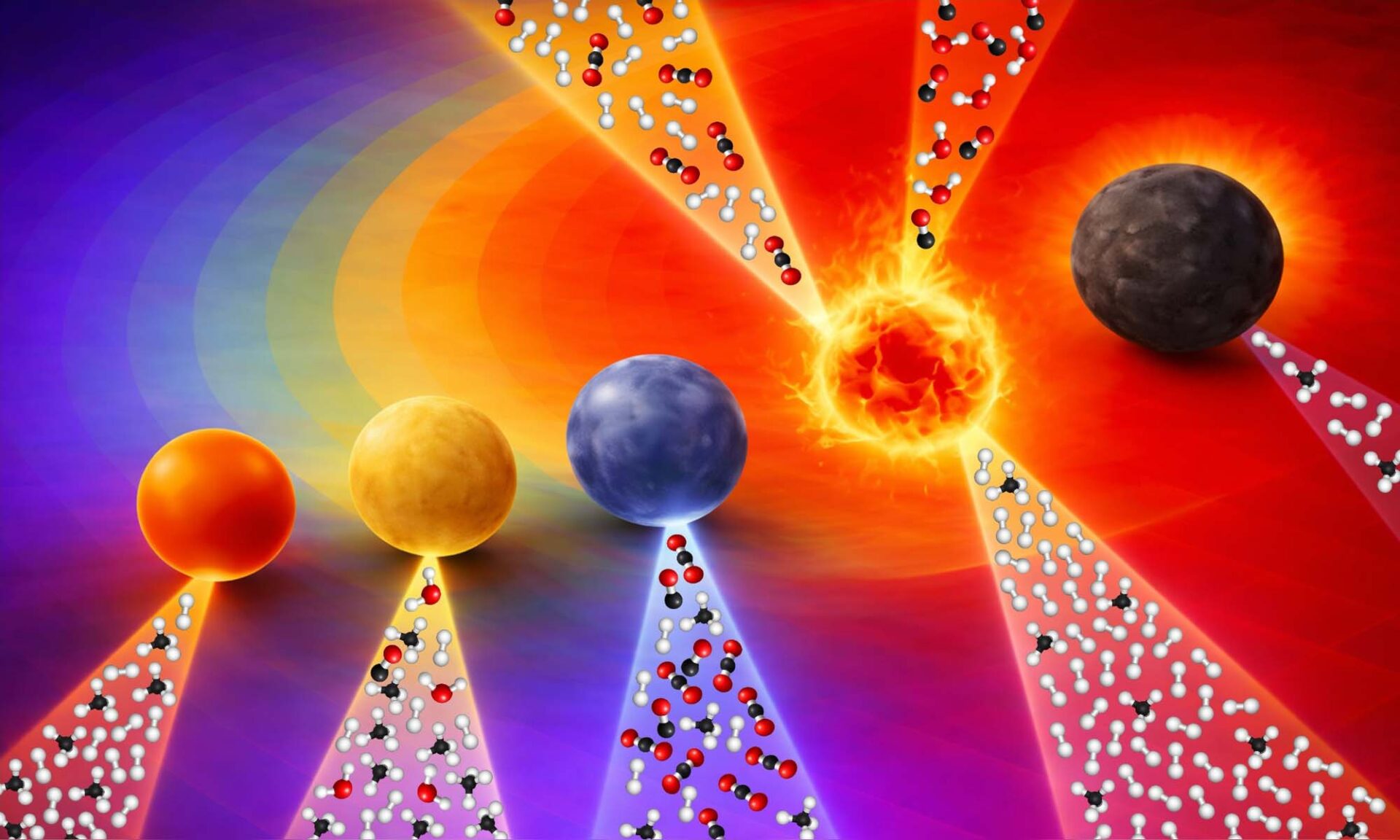
With computational models, researchers at Lawrence Livermore National Laboratory identified a pathway for a carbon monoxide and oxygen mixture to form a polymer that retains its stability even after it decompresses. (Image: Stanimir Bonev)
<関連情報>
- https://www.llnl.gov/article/53936/fleeting-stable-scientists-uncover-recipe-new-carbon-dioxide-based-energetic-materials
- https://www.nature.com/articles/s42004-025-01802-w
ポリマー状二酸化炭素を準安定な高エネルギー物質として得るための代替高圧経路の予測 Prediction of an alternative high-pressure route to polymeric carbon dioxide as a metastable energetic material
Reetam Paul,Jonathan C. Crowhurst & Stanimir A. Bonev
Communications Chemistry Published:10 December 2025
DOI:https://doi.org/10.1038/s42004-025-01802-w
Abstract
The use of pressure to obtain new materials that can be recovered under ambient conditions is a central problem in high-pressure physics. Despite decades of research, this goal has only been achieved in the laboratory for a few notable examples, such as diamond and cubic boron nitride. An area of significant interest is the transformation under compression of light-element molecular compounds to extended covalent-bonded (polymeric) solids. Among them, CO2 has been extensively studied because of its status as a prototypical simple molecular system with a rich phase diagram and due to its fundamental role in Earth’s physics and chemistry. One of its polymeric crystalline phases, accessible at extreme pressures and temperatures, has been recently quenched to ambient pressure, but below room temperature. Here we report ab initio calculations predicting that isothermal compression of a carbon monoxide and oxygen mixture (CO+O2), rather than the compound CO2, lowers the onset of C-polymerization at room temperature from ~ 118 GPa to ~ 7 GPa (complete by ~ 23 GPa). Moreover, it leads to the formation of an intrinsically different polymer with enhanced metastability. We predict that this dense phase is an energetic material which can potentially be recovered to ambient pressure and temperature.