2026-03-11 中国科学院(CAS)
<関連情報>
- https://english.cas.cn/newsroom/research-news/202603/t20260318_1152854.shtml
- https://iopscience.iop.org/article/10.3847/1538-4357/ae2602
ALMA-QUARKSサーベイ:高温分子核は、大質量原始星の進化における長年の現象である The ALMA-QUARKS Survey: Hot Molecular Cores Are a Long-standing Phenomenon in the Evolution of Massive Protostars
Dezhao Meng, Tie Liu, Jarken Esimbek, Sheng-Li Qin, Guido Garay, Paul F. Goldsmith, Jianjun Zhou, Xindi Tang, Wenyu Jiao, Yan-Kun Zhang,…
The Astrophysical Journal Published: 2026 January
DOI:10.3847/1538-4357/ae2602
Abstract
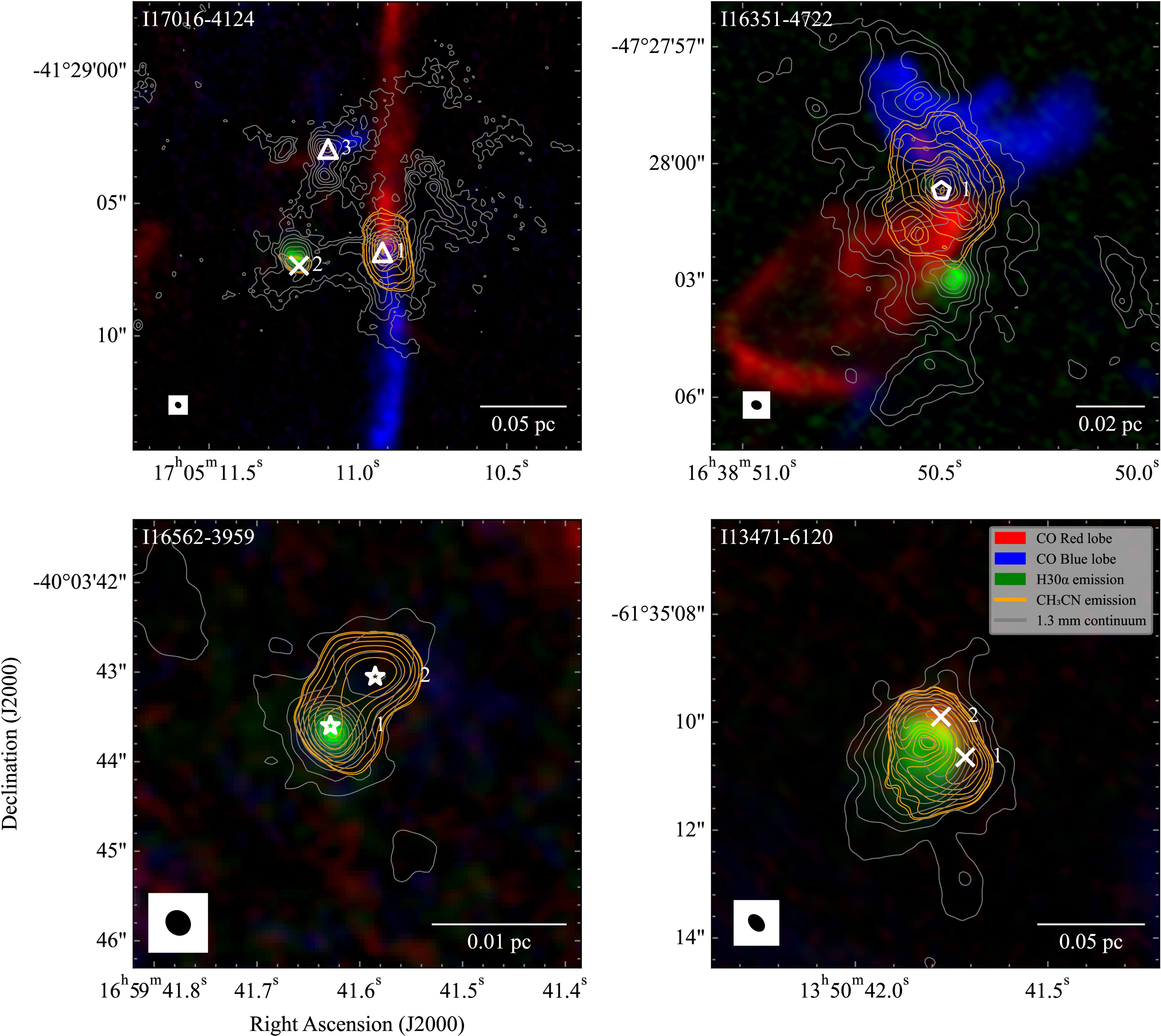
We present an analysis of the QUARKS survey sample, focusing on protoclusters where hot molecular cores (HMCs; traced by CH3CN (12–11)) and HC/UC H ii regions (traced by H30α/H40α) coexist. Using the high-resolution, high-sensitivity 1.3 mm data from the QUARKS survey, we identify 125 hot molecular fragments (HMFs), which represent the substructures of HMCs at higher resolution. From line integrated intensity maps of CH3CN (123–113) and H30α, we resolve the spatial distribution of HMFs and HC/UC H ii regions. By combining with observations of 12CO (2–1) outflows and 1.3 mm continuum, we classify HMFs into four types: HMFs associated with jetlike outflow, wide-angle outflow, and nondetectable outflow and shell-like HMFs near HC/UC H ii regions. This diversity possibly indicates that the hot core could be a polymorphic and long-standing phenomenon in the evolution of massive protostars. The separation between HMFs and H30α/H40α emission suggests that sequential high-mass star formation within young protoclusters is not likely related to feedback mechanisms.