2026-03-13 産業技術総合研究所
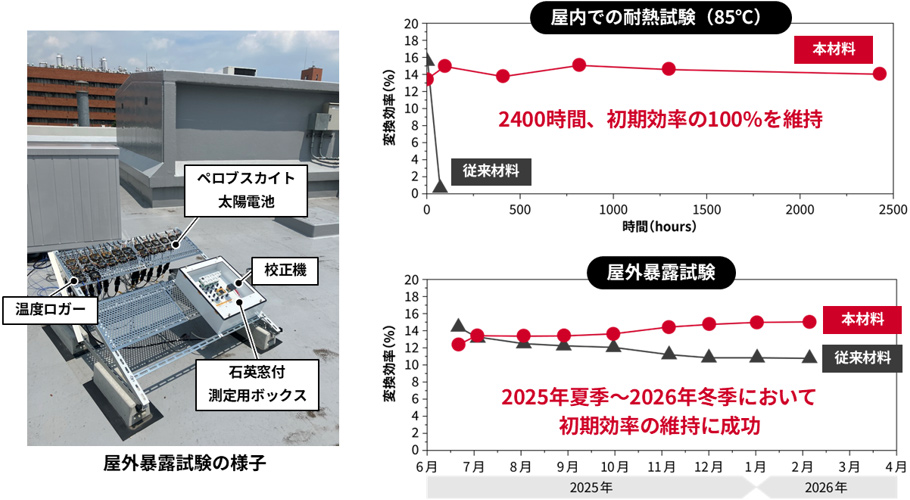
概要図 ペロブスカイト太陽電池の耐熱性および屋外耐久性
※参考文献の図を改変したものを使用しています。
<関連情報>
- https://www.aist.go.jp/aist_j/press_release/pr2026/pr20260313_2/pr20260313_2.html
- https://www.nature.com/articles/s41467-025-68236-9
正孔輸送層用のヘテロアリール誘導体は、ペロブスカイト太陽電池の熱安定性を向上させる Heteroaryl derivatives for hole-transport layers improve thermal stability of perovskite solar cells
Hiroyuki Kanda,Santa Mondal,Naoto Eguchi,Naoyuki Nishimura,Yoyo Hinuma,Kohei Yamamoto,Masaki Yumoto,Kenichi Tashiro,Hideyuki Takada,Aiko Narazaki,Takashi Koida & Takurou N. Murakami
Nature Communications Published:13 February 2026
DOI:https://doi.org/10.1038/s41467-025-68236-9
Abstract
The thermal stability of perovskite solar cells (PSCs) remains a critical challenge for their integration into power grid applications. Here, we report the thermally stable PSCs by employing heteroaryl additives in the Spiro-OMeTAD. These additives effectively control void formation in the hole-transport layer and minimize reactivity with the perovskite layer, significantly improving the thermal stability of PSCs at 85 °C. As a result, PSCs with 3-phenylpyridine and 2-phenylpyridine maintained 101% and 104% of their initial photoconversion efficiency after 2400 hours of 85 °C test, respectively. As an added benefit, photovoltaic performance achieved a photoconversion efficiency of 25%. Also, the outdoor test shows 90% of the initial power point voltage after 1570 hours with maximum-power point tracking, showing remarkable light and cycle stability. We revealed the mechanism of how the additive can improve the thermal stability of PSCs by comparing 36 heteroaryl derivatives and 60 additive combinations.