2026-03-12 東京科学大学
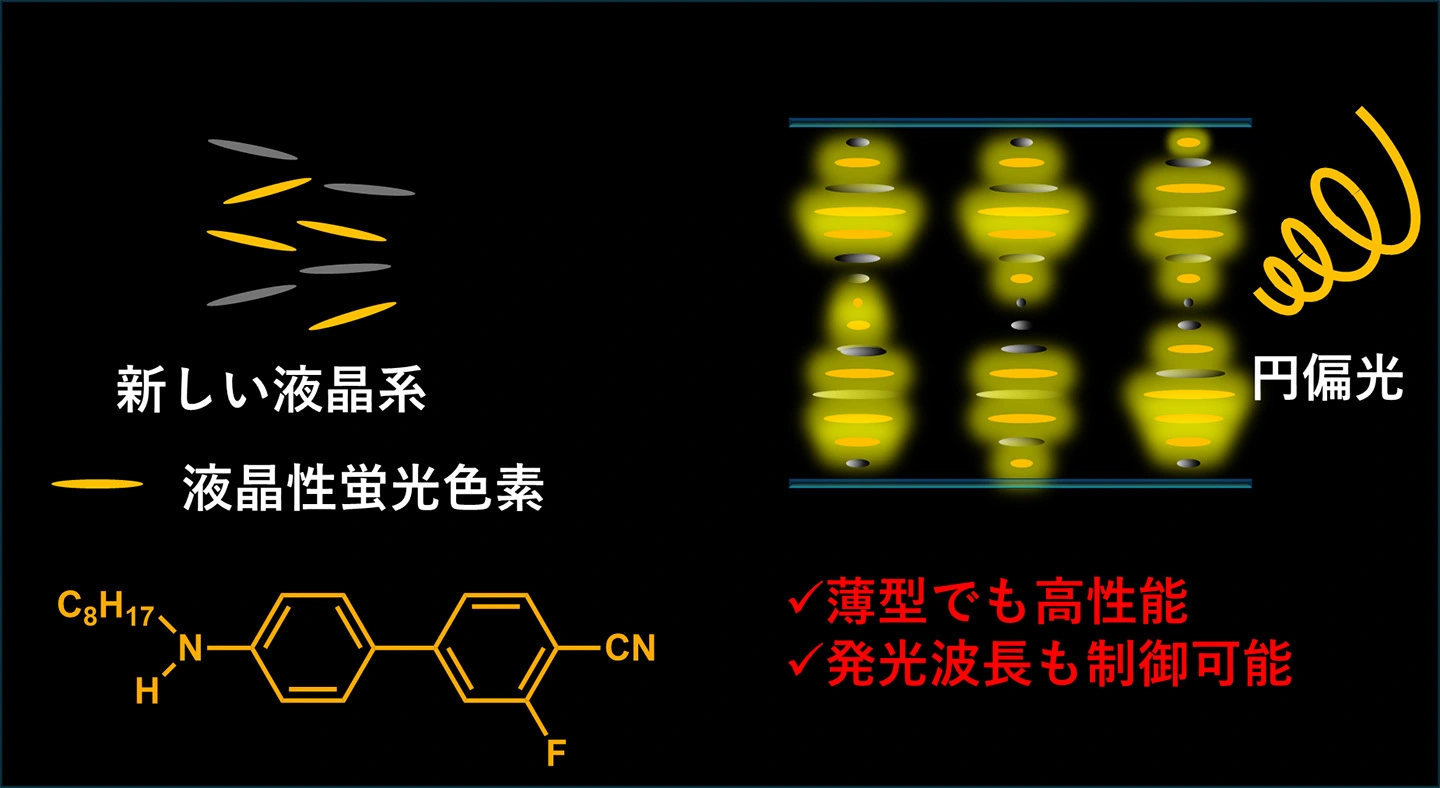
図1. 本研究の概要
<関連情報>
高い非対称因子の円偏光発光を指向した、液晶性蛍光体から構成されるコレステリック液晶の開発 Development of a Cholesteric Liquid Crystal Comprising a Mesogenic Fluorophore for Circularly Polarized Luminescence With a High Dissymmetry Factor
Yuuto Iida, Masayuki Gon, Hiroyuki Yoshida, Kazuo Tanaka, Gen-Ichi Konishi
Aggregate Published: 27 February 2026
DOI:https://doi.org/10.1002/agt2.70304
ABSTRACT
Circularly polarized luminescence (CPL) has attracted considerable attention owing to its wide range of potential applications. Cholesteric liquid crystals (CLCs) are promising candidates for CPL-active materials because of their ease of fabrication, stimulus responsiveness, and ability to achieve high dissymmetry factors (|glum|). In most studies on CPL-active CLCs, non-mesogenic luminophores are doped into commercially available liquid crystals (LCs). However, their low solubility in LCs (typically only a few wt%) and their tendency to disrupt LC alignment present challenges in achieving high |glum| values—particularly in thin cells—and in broadening the CPL spectra. Here, we report a new LC mixture comprising our previously designed mesogenic fluorophore and a commercially available LC. This strategy enables a markedly increased luminophore loading (up to ∼50 wt%) and enhances the birefringence of the LC matrix. As a result, we achieved a notably high |glum| value of 1.25 even in thin cells (2 µm), together with significantly broadened CPL spectra. Furthermore, the emission wavelength was successfully tuned via Förster resonance energy transfer. This work demonstrates a rational design strategy for LC mixtures that yield CPL materials with high |glum|, advances the fundamental understanding of CPL generation in photoluminescent CLCs, and highlights their potential for future photonic and optoelectronic applications.