026-03-10 中国科学院(CAS)
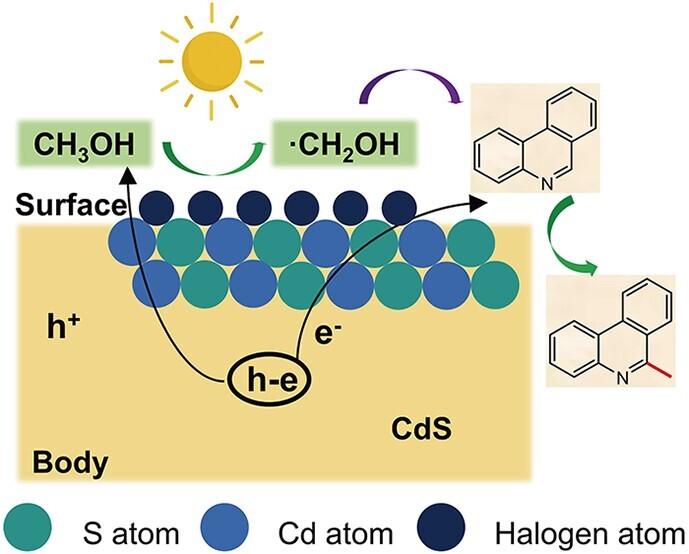
Schematic diagram of surface halogen (Cl, Br and I) passivation (Image by LI Jingxin)
<関連情報>
- https://english.cas.cn/newsroom/research-news/202603/t20260310_1152352.shtml
- https://pubs.acs.org/doi/10.1021/jacs.5c19863
表面ハロゲン不動態化により、効率的なメタノール光活性化のための超安定金属硫化物を実現 Surface Halogen Passivation Enables Ultra-Stable Metal Sulfide for Efficient Methanol Photoactivation
Yi Liu,Gang Chen,Lei Li,Hanghao Ying,Hui Wang,Zongpeng Song,Haiou Zhu,Xiaodong Zhang,and Yi Xie
Journal of the American Chemical Society Published: February 10, 2026
DOI:https://doi.org/10.1021/jacs.5c19863
Abstract
Transition metal sulfides exhibit promising photocatalytic activity for high-value-added chemical synthesis; however, they suffer from significant photocorrosion and rapid deactivation during reactions. In this study, we propose a surface halogen (Cl, Br, and I) passivation strategy to improve the stability of photocatalysts, which would provide a protective barrier against chemical attack, preventing oxidative and reductive surface degradation. By taking the typical metal sulfide catalysts of CdS as a representative model, we show that the introduced surface halogen can effectively suppress surface leakage of sulfur or cadmium ions under continuous photoirradiation, in stark contrast to the extensive structural damage observed in pristine CdS. Moreover, the halogen-passivated catalyst showed exceptional photocatalytic efficiency attributable to accelerated charge-transfer kinetics that expedite exciton dissociation and interfacial electron transport. These improvements enable effective methanol activation and selective C(sp3)–H methylation of heteroarenes even at ultralow irradiance, where the Cl-passivated CdS achieves a yield up to 90%, far exceeding the trace yield of pristine CdS. This study provides fundamental insights into the role of surface halogen passivation in optimizing photostability and electronic structure in photocatalysis.