2026-03-09 中国科学院(CAS)
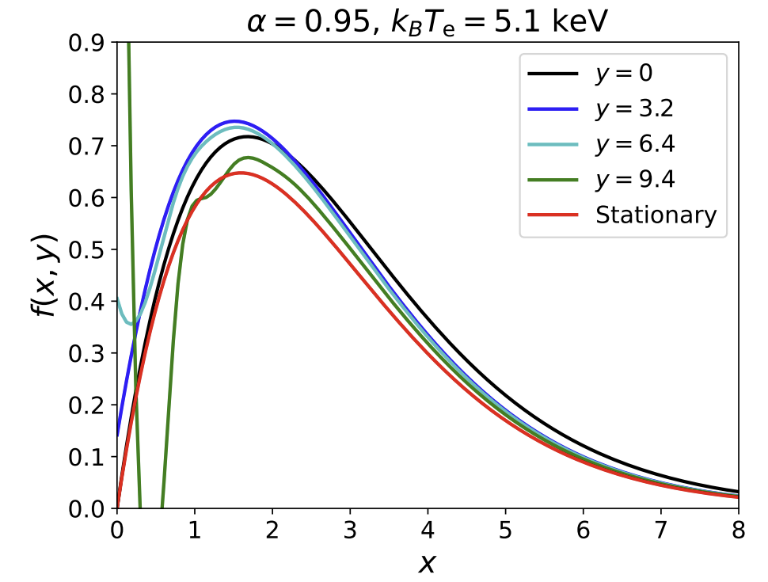
Numerical simulations of the evolution of the photon distribution over time, based on the modified Kompaneets equation, are presented. (Image by IMP)
<関連情報>
- https://english.cas.cn/newsroom/research-news/202603/t20260310_1152354.shtml
- https://iopscience.iop.org/article/10.3847/1538-4357/ae42cc
冷電子媒質における下方散乱からの光子ボーズ・アインシュタイン凝縮の出現 Emergence of Photon Bose–Einstein Condensation from Down-scattering in Cold Electron Media
Bing’ang Guo, Wei Kou, and Xurong Chen
The Astrophysical Journal Published: 2026 February 26
DOI:10.3847/1538-4357/ae42cc
Abstract
In this study, we investigate the kinematic enhancement of photon Bose–Einstein condensation (BEC) resulting from the interaction of high-energy photons with a cold electron gas. We employ a modified form of the Kompaneets equation that incorporates higher-order kinematic recoil corrections while retaining the Thomson scattering cross-section as a semianalytical approximation. Beginning with an initial blackbody photon spectrum, we perform numerical simulations to track the evolution of the photon distribution under the influence of inverse Compton scattering. Under the assumption of a strictly conserved photon number, our results demonstrate a pronounced enhancement of photon-number density at the low-energy tail, indicative of a BEC. This phenomenon is further corroborated by an analysis of the entropy evolution. Furthermore, we discuss the role of photon-number-violating processes, such as bremsstrahlung and double Compton scattering. We find that in realistic astrophysical plasmas, these absorption mechanisms act as efficient sinks, likely suppressing the formation of the condensate. These findings clarify the competition between scattering-induced accumulation and absorption-induced dissipation in cold electron environments.