
2026-03-06 NASA
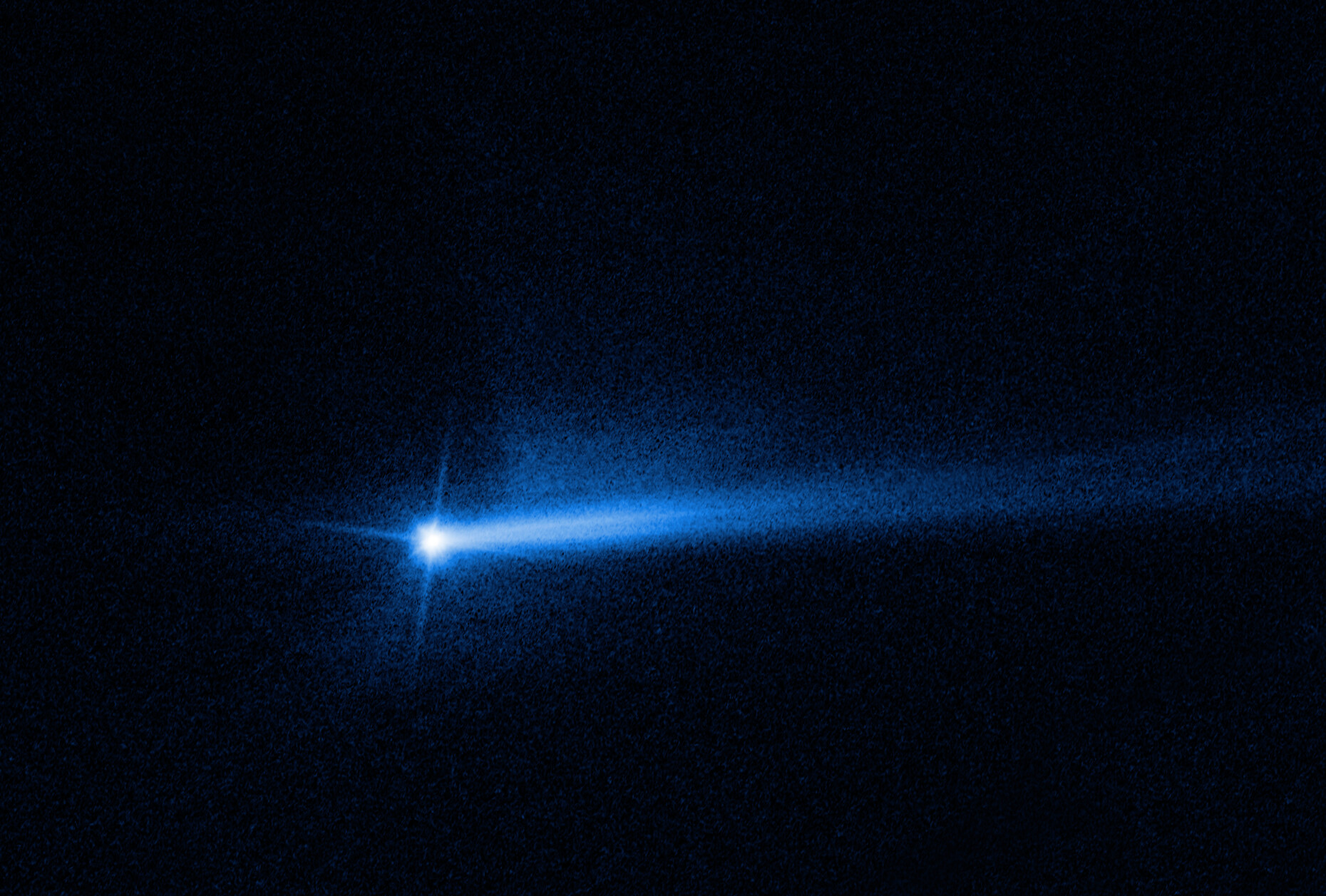
The Hubble Space Telescope observed two tails of dust ejected from the Didymos-Dimorphos asteroid system several days after NASA’s DART spacecraft impacted the smaller asteroid.NASA, ESA, Jian-Yang Li (PSI), Joe Depasquale (STScI)
<関連情報>
- https://www.nasa.gov/missions/dart/nasas-dart-mission-changed-orbit-of-asteroid-didymos-around-sun/
- https://www.science.org/doi/10.1126/sciadv.aea4259
小惑星の太陽中心軸からの偏向の直接検出:DART後のディディモスシステム Direct detection of an asteroid’s heliocentric deflection: The Didymos system after DART
Rahil Makadia, Steven R. Chesley, David Herald, Davide Farnocchia, […] , and Siegfried Eggl
Science Advances Published:6 Mar 2026
Abstract
In September 2022, NASA’s Double Asteroid Redirection Test (DART) spacecraft crashed into Dimorphos and demonstrated the kinetic impact method of protecting Earth from asteroids. A fraction of the impulse delivered to Dimorphos was also imparted onto the Didymos system’s barycenter, changing its heliocentric orbit. Here, we present the first-ever measurement of human-caused change in the heliocentric orbit of a celestial body. Thanks to stellar occultation and radar measurements, we estimate that the Didymos system experienced an along-track velocity change of −11.7 ± 1.3 micrometers per second. We constrain the heliocentric momentum enhancement factor for DART at 2.0 ± 0.3 and the bulk densities of Didymos and Dimorphos at 2600 ± 140 and 1540 ± 220 kilograms per cubic meter, respectively. Our results demonstrate that targeting the secondary asteroid in binary systems constitutes a possible strategy for kinetic impact deflection, adding to humanity’s planetary defense capabilities.


