2026-03-03 イェール大学
<関連情報>
- https://news.yale.edu/2026/03/03/ais-hidden-bias-chatbots-can-influence-opinions-without-trying
- https://academic.oup.com/pnasnexus/article/5/3/pgag022/8503065
AIが生成した歴史物語における潜在的バイアスと誘発バイアスが世論にどのような影響を与えるか How latent and prompting biases in AI-generated historical narratives influence opinions
Matthew Shu,Daniel Karell,Keitaro Okura,Thomas R Davidson
PNAS Nexus Published:03 March 2026
DOI:https://doi.org/10.1093/pnasnexus/pgag022
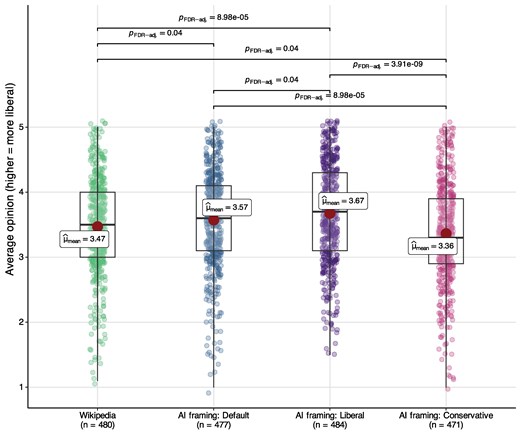
Abstract
Large language models (LLMs) can be used to persuade people on a range of issues, particularly through user-driven strategies such as personalizing messages and dialogues intended to change minds. However, their capacity to influence opinions through subtle, latent ideological framing remains relatively understudied. We investigate whether AI-generated historical summaries affect social and political opinions through a preregistered experiment (N = 1,912). Participants read Wikipedia or GPT-4o summaries of two historical events, with AI summaries maintaining factual accuracy while exhibiting different types of framing biases. Default AI summaries led to more liberal opinions compared with Wikipedia, demonstrating the persuasive capability of LLM’s latent biases. Summaries purposefully induced with a liberal framing also led to more liberal opinions, regardless of readers’ ideologies. Summaries constructed with a conservative framing produced conservative shifts primarily among conservative readers. These findings demonstrate that the use of AI for learning history can influence opinions through both intrinsic and intentional framing mechanisms, even when the content remains factually accurate. As AI becomes integral to information acquisition, recognizing pathways of influence based not only on user-manipulated content but also on models’ latent biases is essential for understanding AI’s broader societal impacts.