2026-03-02 岡山大学,北海道大学
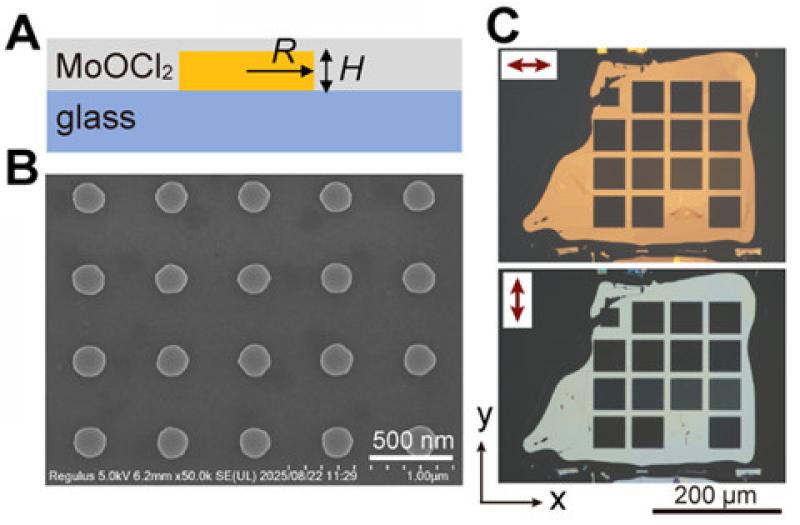
右図A:シリカガラス基板上のMoOCl2のナノ構造の模式図、B:代表的なMoOCl2の円形ナノ構造の電子顕微鏡写真(半径:87 ナノメーター(nm)、高さ:50 nm、構造間距離:500 nm)、C:反射顕微鏡で測定した構造全体の光学イメージ。上図はMoOCl2の金属的性質を持つ方向の直線偏光を照射、下図は絶縁体的性質を持つ方向の直線偏光を照射。
<関連情報>
- https://www.okayama-u.ac.jp/tp/release/release_id1506.html
- https://www.okayama-u.ac.jp/up_load_files/press_r7/press20260302-1.pdf
- https://www.nature.com/articles/s41467-026-69435-8
異方性2D材料における双曲局在プラズモンとねじれ誘起カイラリティ Hyperbolic localized plasmons and twist-induced chirality in an anisotropic 2D material
Yaolong Li,Xu Shi,Yuxin Zhang,Yen-En Liu,Hong Yang,Guowei Lyu,Yasutaka Matsuo,Xiaoyong Hu,Qihuang Gong & Hiroaki Misawa
Nature Communications Published:13 February 2026
DOI:https://doi.org/10.1038/s41467-026-69435-8 Unedited version
Abstract
Two-dimensional (2D) van der Waals materials with strong in-plane anisotropy are emerging as fertile platforms for nanophotonics beyond conventional isotropic noble metals and dielectrics. Here, we demonstrate hyperbolic localized plasmon resonances (H-LPRs) in MoOCl2, a representative anisotropic 2D crystal. Unlike conventional plasmons, H-LPRs arise directly from the crystal anisotropy and show unprecedented properties: (i) one-dimensional resonances in circularly symmetric nanodisks, (ii) Z-gap independence in metal–insulator–metal heterostructures, and (iii) twist-induced chirality with circular dichroism values exceeding 0.65. The H-LPRs are characterized by both far-field spectra and near-field imaging. By stacking twisted MoOCl2 flakes, we bridge H-LPRs with concepts of moiré photonics and twistronics, introducing a new degree of freedom in plasmonic design. These findings establish H-LPRs in anisotropic 2D materials as a generalizable and versatile platform for polarization engineering, ultrasensitive chiral sensing, and integration into compact on-chip and quantum nanophotonic devices.