2026-02-26 バース大学
<関連情報>
- https://www.bath.ac.uk/announcements/new-technology-could-use-sunlight-to-break-down-forever-chemicals/
- https://pubs.rsc.org/en/content/articlelanding/2026/ra/d5ra07284k
本質的に微多孔性のポリマー(PIM-1)は、グラファイト状炭素窒化物(g-C3N4)におけるヘプタデカフルオロ-1-ノナノールの分解を促進した Intrinsically microporous polymer (PIM-1) enhanced degradation of heptadecafluoro-1-nonanol at graphitic carbon nitride (g-C3N4)
Fernanda C. O. L. Martins,Wanessa R. Melchert, Akalya Karunakaran,Chris R. Bowen, Nicholas Garrod,Philip J. Fletcher,Mariolino Carta,Dominic Taylor,Neil B. McKeown and Frank Marken
RSC Advances Published:02 Jan 2026
DOI:https://doi.org/10.1039/D5RA07284K
Abstract
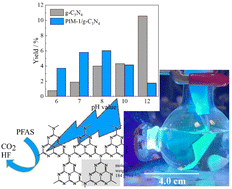
The photochemical transformation of polyfluorinated alkyl substances (PFAS) leads to structural unzipping to give rise to fluoride and further degradation products depending on (i) the type of photocatalyst as well as on (ii) microporous coatings or reaction environments. Here, a substantial increase in photocatalyst performance is observed by coating graphitic carbon nitride (g-C3N4) with an intrinsically microporous polymer (PIM-1) to enhance interaction with heptadecafluoro-1-nonanol (as a PFAS model).