2026-02-25 東京科学大学
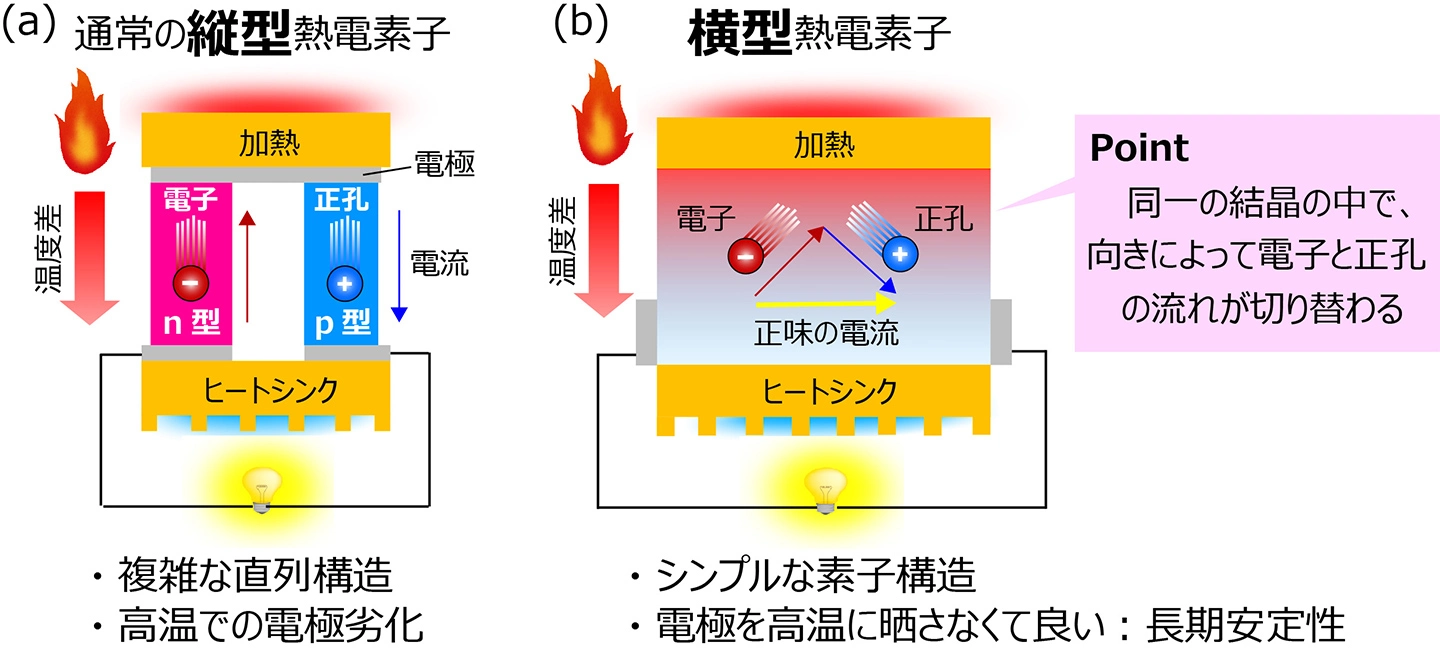
図1. 通常の「縦型」熱電素子(a)と「横型」熱電素子(b)の構造と動作原理。縦型熱電素子では、温度勾配と同一方向に電流が流れる。横型熱電素子では、結晶の向きによって電子または正孔の流れる方向が異なる材料を45度程度傾けて用いることで、温度勾配に垂直な方向に正味の電流を取り出すことができる。
<関連情報>
軸依存伝導極性:横方向熱電材料の設計原理と高スループット発見 Axis-Dependent Conduction Polarity: Design Principles and High-Throughput Discovery of Transverse Thermoelectrics
Zan Yang,Xinyi He,Hidetomo Usui,Toshio Kamiya,and Takayoshi Katase
Journal of the American Chemical Society Published: February 4, 2026
DOI:https://doi.org/10.1021/jacs.5c22733
Abstract
Some semiconductor materials exhibit axis-dependent conduction polarity (ADCP), where carrier transport is dominated by electrons along one crystallographic axis and holes along another. This unconventional transport behavior enables transverse thermoelectricity and other functionalities that are inaccessible in conventional isotropic/unipolar semiconductors. However, only a few ADCP materials have been identified, largely because the underlying electronic design principles have remained unclear. Here, we establish a quantitative framework that defines the electronic conditions required for ADCP to emerge and remain robust. Using a minimal two-band tight-binding model, we clarify that ADCP requires two key electronic conditions: a sufficiently small band gap that enables simultaneous electron–hole transport and strong anisotropy in carrier effective masses that causes their transport contributions to differ between axes. These parameters define a chemical-potential window in which axis-resolved Seebeck coefficients take opposite signs, identifying narrow-gap semiconductors and semimetals with anisotropic band edges as prime ADCP candidates. Guided by these criteria, we conduct a first-principles screening of 4282 anisotropic narrow-gap semiconductors and metals and identify 361 ADCP materials, which are predominantly found among chalcogenides, pnictides, and tetrel-based compounds, including 57 potential transverse thermoelectrics. Analysis of two representative materials, AlReGe and ZrSe3, reveals that ADCP originates from anisotropic band-edge states derived from low-dimensional bonding networks, resulting in spatially separated electron and hole transport on different crystal sublattices. These results provide chemically intuitive design rules for ADCP materials and establish a comprehensive data set for accelerating the development of transverse thermoelectrics and other next-generation electronic devices.