
2026-02-20 東京大学
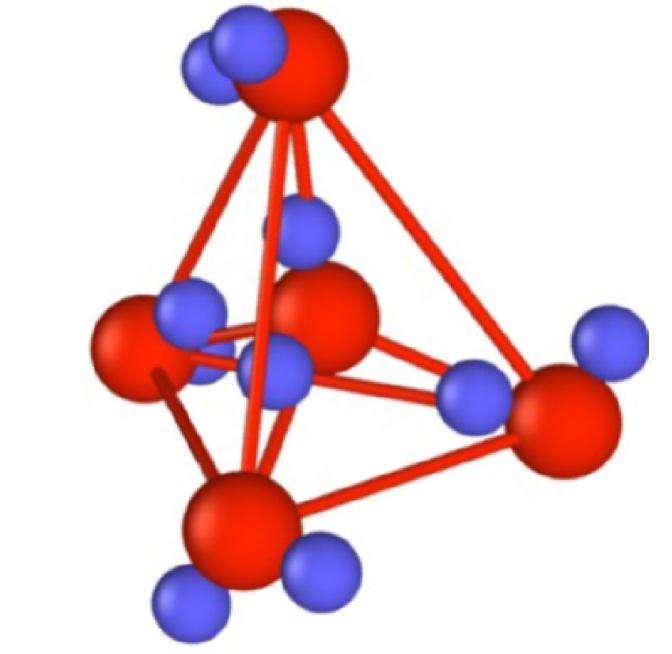
水の正四面体構造(S状態)
<関連情報>
- https://www.rcast.u-tokyo.ac.jp/ja/news/release/20260220_2.html
- https://www.nature.com/articles/s41467-026-69356-6
競合する水素結合秩序が水の異常な表面張力を生み出す Competing hydrogen-bond orders drive water’s anomalous surface tension
Jiaxing Yuan,Kun Qiu,Gang Sun & Hajime Tanaka
Nature Communications Published:20 February 2026
DOI:https://doi.org/10.1038/s41467-026-69356-6
Abstract
Water’s surface tension shows a nonlinear temperature dependence, including a reentrant increase in the supercooled regime — a longstanding puzzle in physical chemistry. Using molecular dynamics simulations, we uncover a structural mechanism linking microscopic ordering to macroscopic interfacial behaviour. Surface tension arises from the interplay between ρ-states, characterised by O–H alignment under surface symmetry breaking, and tetrahedral S-states stabilised in the subsurface by negative pressure. Water’s surface tension γ is governed by the interplay of their anisotropies: at intermediate temperatures, ρ-state anisotropy saturates while S-states remain weakly anisotropic, slowing the growth of γ. Upon deeper supercooling, however, S-states acquire orientational order, amplifying anisotropy and producing the reentrant rise. This unified framework explains both inflection points of γ(T) and establishes a structural–mechanical link between local hydrogen-bond motifs and interfacial stress, with implications for nucleation, cryopreservation, and ferroelectric-like ordering, and extending beyond water to other network-forming liquids.


