2026-02-24 高エネルギー加速器研究機構,東北大学,国立極地研究所,海洋研究開発機構
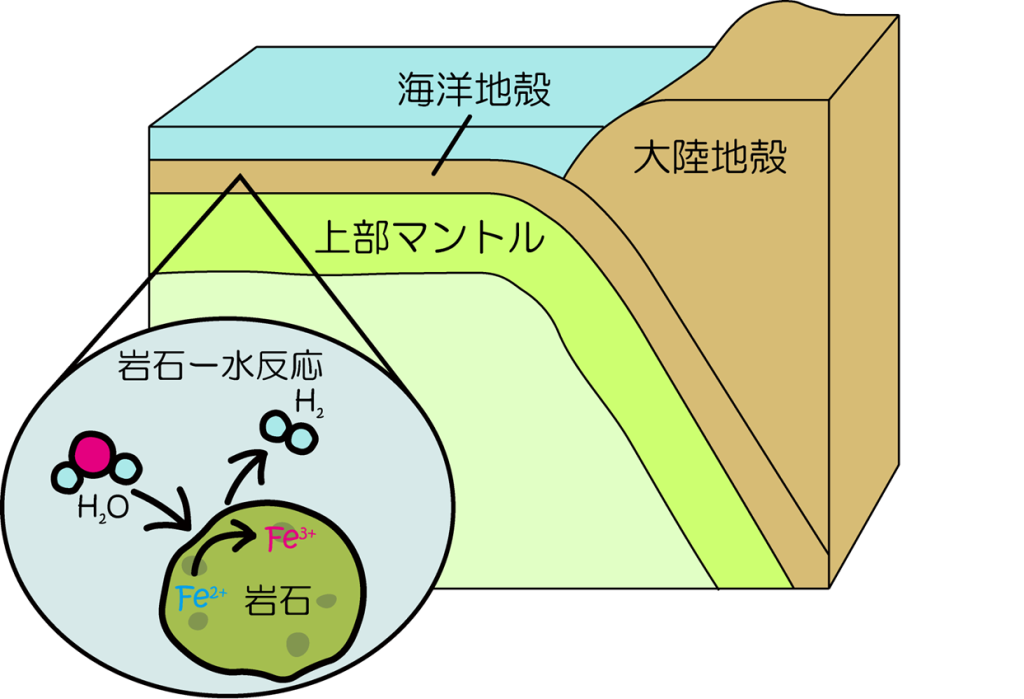
図1. 海洋底の地質構造の模式図と、岩石と水が反応する様子を示した概念図。厚さが約7kmの海洋地殻の下には上部マントルが存在している。海洋底の一部の場所では、これらの岩石と水(海水)が反応している。
<関連情報>
- https://www.kek.jp/ja/press/202602241400
- https://www.kek.jp/wp-content/uploads/2026/02/pr202602241400.pdf
- https://www.sciencedirect.com/science/article/abs/pii/S0016703726000827
オマーンオフィオライトの下部地殻とマントル部における蛇紋岩化に伴う多段階水素生成の深度変化 Depth variations in multi-stage hydrogen generation associated with serpentinization in the lower crust and mantle sections of the Oman Ophiolite
Kazuki Yoshida, Atsushi Okamoto, Ryosuke Oyanagi, Masakazu Fujii, Kenta K. Yoshida, Yasuhiro Niwa, Yasuo Takeichi, Masao Kimura
Geochimica et Cosmochimica Acta Available online: 12 February 2026
DOI:https://doi.org/10.1016/j.gca.2026.01.055
Abstract
Oxidation of ferrous Fe in Fe-bearing minerals during serpentinization has a key role in the production of H2, which is an energy source for microbial communities within the oceanic lithosphere. Serpentinization of the oceanic lithosphere occurs at various stages and temperatures, and in a range of rock types. However, the temporal and spatial variations in H2 generation during alteration of the oceanic lithosphere are poorly constrained. In this study, we investigated Fe partitioning and H2 generation in the oceanic lithosphere using samples of drillcore recovered from the lower crust and upper mantle sections at the Oman Drilling Project CM site, based on bulk-rock chemistry, thermogravimetric analyses, magnetic analyses, and bulk-rock and two-dimensional imaging using Fe K-edge X-ray absorption near edge structure spectroscopy.
Depth profiles of loss-on-ignition values indicate there was broadly consistent extent of serpentinization of the crust–mantle transition zone (serpentinized dunite) and mantle section (serpentinized harzburgite). The bulk-rock molar Fe3+/ΣFe ratios show no systematic variations with depth, but vary with rock type. The two-dimensional X-ray absorption near edge structure imaging revealed variations in the Fe oxidation state in relation to rock type and mineral texture. The mesh texture serpentine has a similar Fe3+/ΣFe ratio regardless of rock type. Serpentine near magnetite veins that cut the mesh texture in dunite and harzburgite has higher Fe3+/ΣFe ratios than mesh texture serpentine. The Fe oxidation state varies with texture, indicating that the redox conditions during serpentinization changed spatially or temporally. The H2 was generated mainly in the early-stage serpentinization characterized by mesh texture. The amounts of H2 generated during the mesh-texture serpentinization in the olivine gabbro (24–307 mmol/kgrock) and wehrlite (81–366 mmol/kgrock) are comparable to that in the dunite (143–393 mmol/kgrock) and harzburgite (71–151 mmol/kgrock). In addition to the H2 generated during mesh-texture serpentinization, up to 280 mmol/kgrock of H2 may have been generated during the later-stage formation of magnetite veins in dunite and harzburgite. Brucite in the serpentinized dunite and harzburgite contains a considerable amount of ferrous Fe. If the reaction of Fe-rich brucite to magnetite could have occurred in response to the increase in the water/rock ratio (W/R) that accompanied fracturing, it could have generated a considerable amount of H2. In contrast, during the later stages of serpentinization of the olivine gabbro and plagioclase-bearing wehrlite, the supply of silica from plagioclase suppressed the formation of magnetite and H2 generation. The depth variations of the amount and oxidation state of Fe in the lower crust and upper mantle sections of the Oman Ophiolite highlight the spatial and temporal heterogeneity in H2 production during the alteration of the oceanic lithosphere.